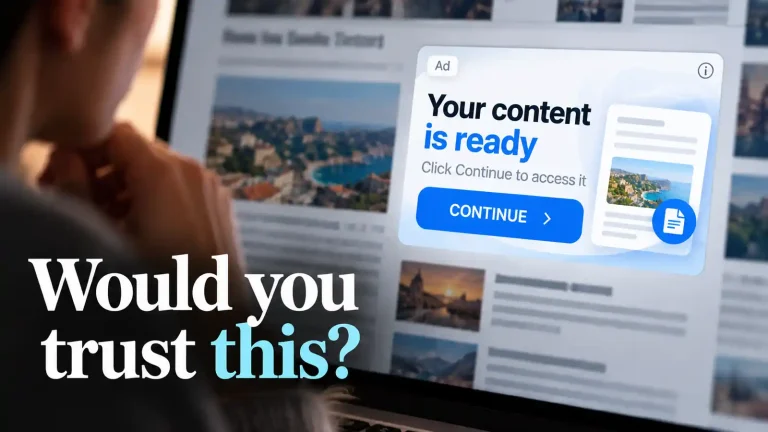

What this article covers
This article looks at why so many online ads seem ridiculous, repetitive, or strangely overdramatic — and why advertisers may keep running them anyway. It explores how performance-driven ad systems, low-cost AI production, aggressive hooks, and repetition shape what you see. It also asks whether some ads are deliberately absurd and where the line is between stupid, misleading, and fraudulent.
Open YouTube and, before the video you wanted has even started, a very serious person is explaining that you have been doing something ordinary completely wrong for years.
“Never say these three words.”
“Stop doing this immediately.”
“Your first sentence decides everything.”
Then comes the solution: a quiz, a course, an app or a “personalized” plan you apparently needed without knowing it.
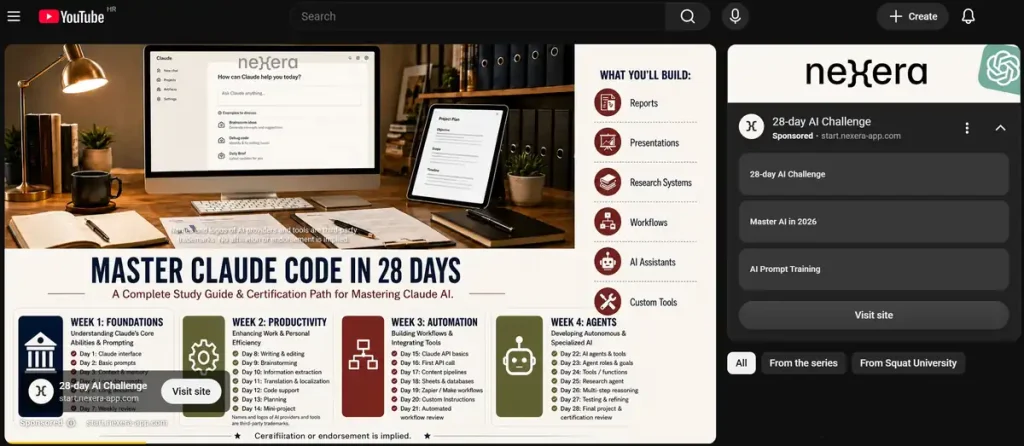
The presenter may be in a modern office or an expensive car. Sometimes the authority comes from a claimed background coaching CEOs or doctors. Sometimes the presenter is AI. In one Nexera ad we saw, a polished man in a suit appeared with the label “AI Actor Portrayal” while the message on screen said: “PLEASE start mastering Claude if you’re 40+.”
If ads like these can look so ridiculous, why do advertisers keep running them?
There is no single answer. Online advertising rewards ads that get a response, not good taste.
The ad doesn’t have to convince everyone
An online ad can fail with most people and still be useful even if only a small group clicks, signs up or buys.
Imagine 10,000 people see it. Most skip it. Some laugh. Some get annoyed. But if enough continue through a quiz, trial or checkout, the advertiser may still get what it wants.
An ad simply does not need broad approval to be useful.
So “people hate this ad” and “this ad works” can both be true.
The system rewards what gets a response
Google, Meta and other platforms give advertisers tools designed to find people who are more likely to click, sign up, install an app or buy something. Google’s own documentation describes its automated ad systems as working toward the goals advertisers choose.
The important part is simple. The system is not asking, “Which ad will most people consider clever or tasteful?” It is asking which ad is more likely to get the action the advertiser wants.
Advertisers can compare different openings, presenters, thumbnails, headlines or videos. We cannot see a company’s internal testing, so we should not pretend to know why one version was chosen. But testing lots of different versions is easier than ever.
And “Did this look embarrassing?” is not a standard advertising goal.
AI makes it cheaper to make more versions
Generative AI makes this kind of testing faster and cheaper.
A company can create presenters, voices, images and many versions of the same video without organizing a new shoot every time. It can change the hook, language or visual style and make more versions for testing.
That can help legitimate businesses. It can also produce mediocre advertising very quickly.
The Nexera example is interesting because the ad openly labels the presenter as an “AI Actor Portrayal.” There is nothing inherently deceptive about that. The better questions are what the ad claims and what happens after the click.
Meta’s Oversight Board reviewed an AI-manipulated ad that appeared to show football star Ronaldo Nazário endorsing an online game. A fake celebrity endorsement is very different from a synthetic presenter that is clearly labeled as such.
AI did not invent bad advertising. It just made it much cheaper to make more of it.
Why do so many ads start with “Never…”?
“Never say this.”
“Stop doing this immediately.”
“99% of people get this wrong.”
These openings are not subtle because they have very little time to make you stop.
A calm opening such as “Here is a reasonably priced service you may or may not find useful” may be more honest, but it is not exactly fighting for attention.
A dramatic warning creates an immediate question: what am I doing wrong, and what does this person know that I do not?
Fear, curiosity, insecurity and secret knowledge are old advertising ingredients, squeezed into the first few seconds where attention is hardest to win.
That does not make every dramatic hook deceptive.
The tenth viewing is worse than the first
There is another reason an ad can start to feel absurd: you have seen it too many times.
Research backs up something most of us already suspect. Repetition can make advertising more annoying.
An ad that seemed mildly silly the first time can become unbearable after the tenth. The fake urgency gets louder, and the presenter’s voice starts arriving before you have even processed what you were trying to watch.
From your side, YouTube seems personally committed to showing you the same person explaining that you have been speaking incorrectly for 40 years.
Are some ads deliberately stupid?
This is where a popular theory becomes interesting.
There is real research behind the idea that an obviously suspicious scam can sometimes work as a filter.
Microsoft researcher Cormac Herley studied why classic “Nigerian prince” style scam emails could sound so obviously suspicious. His point was straightforward: sending enormous numbers of messages is cheap, but spending time corresponding with people who will never pay is not. His Microsoft Research paper explains the idea in detail.
An absurd opening can help filter out people who would never continue. Most recipients ignore it. Someone who replies to an obviously suspicious story may be more willing to keep going, leaving the scammer with a smaller group worth pursuing.
Josh Brett’s video investigation, The $295,000,000 Tai Chi Walking Scam, makes a similar connection between bizarre modern ads and Herley’s research. It is an interesting modern example, but Brett is applying Herley’s idea to these ads. Herley’s paper itself does not tell us why any specific YouTube advertiser chose its creative.
And it definitely does not prove that every stupid YouTube ad is secretly designed to “filter out smart people.”
That version of the theory is attractive because it makes every terrible ad look like a hidden master plan. The evidence does not justify going that far.
In some scams, obvious implausibility may help narrow the audience. With ordinary online advertising, a simpler explanation is often enough: the ad only needs enough people to respond.
Stupid, misleading and fraudulent are different things
A ridiculous ad can promote a real product. A real company can use manipulative marketing or make billing and cancellation harder to understand than they should be.
Then there are ads that cross a much more serious line.
A fake celebrity endorsement is not the same thing as an AI presenter clearly labeled as fictional. Hiding important billing information is not the same thing as using an irritating hook. And an actual scam is not simply an ad we dislike.
Platforms have rules against deceptive and fraudulent ads, but moderation is not perfect. Scam ads can get through, along with awful ads that may not actually break the rules.
It helps to separate three questions:
- Is the ad stupid?
- Is it misleading?
- Is the thing behind it fraudulent?
The answers can be completely different.
Sometimes a bad ad is just a bad ad
It is tempting to explain every terrible online ad as the brilliant result of algorithms, psychology and secret filtering.
Sometimes that is giving the ad far too much credit.
The targeting may be poor. The hook may be lazy. The advertiser may have produced 50 AI variations and somehow chosen the one that makes you want to close the tab.
But there are real reasons so many modern ads feel strange. A small response from the right group can matter more than broad approval, AI has lowered production costs, and dramatic hooks have only seconds to interrupt what you were trying to do.
So the next time an ad tells you that one sentence is destroying your life, there is no need to assume the advertiser has discovered a secret about human behavior.
But there is also no reason to assume nobody is clicking.
That may be the strangest part.