
What this article covers
Nexera’s public ads show how familiar selling hooks—including the “I’m begging you” construction — can be reused and reshaped across different presenters, visuals, topical identities and ad records. This article examines those recurring building blocks, the creatives explicitly labeled “AI Actor Portrayal,” and what public ad libraries can reveal about Nexera’s advertising system. It also marks the limits of that evidence, including what it cannot establish about automation or performance.
A man sits at an office desk, with documents in front of him. Across the opening of a Nexera ad, the on-screen text reads: “I’m begging you, please start mastering Claude for Excel if you’re in your 40s.”
In another Nexera ad, a man sits beside the sea, with a microphone extending into the frame. This time, the opening text reads: “I’m begging you — start learning AI filmmaking if you’re 50+.”
The setting changes. So do the age group, the skill and the imagined payoff: getting more capable with workplace software in one ad, learning to make films in the other. But the appeal has a familiar shape. A presenter addresses a particular age group with an urgent personal plea, then gives way to a graphic laying out a learning program.
That repeated construction is a useful way into Nexera’s advertising. Its public ads show familiar AI-learning promises repackaged through different faces, hooks, visual treatments and topical identities. Some reuse the same media. Others put identical audio behind materially different images. Four reviewed creatives explicitly label presenter portrayals as AI actors.
Together, those examples reveal a modular advertising system. They also show where the public view stops: the ads reveal how messages are reused and varied, while leaving the production workflow and business results largely out of sight.
Two ads, the same plea
The Claude-for-Excel ad moves from its office presenter to a Microsoft 365 learning roadmap about five seconds in. The graphic extends the workplace pitch beyond Excel to tools including Word, PowerPoint, Outlook and Teams.
The filmmaking ad makes a similar transition at roughly the same point, replacing the beach interview scene with a film-program poster. Its program graphic covers activities such as storyboarding, video generation and editing.
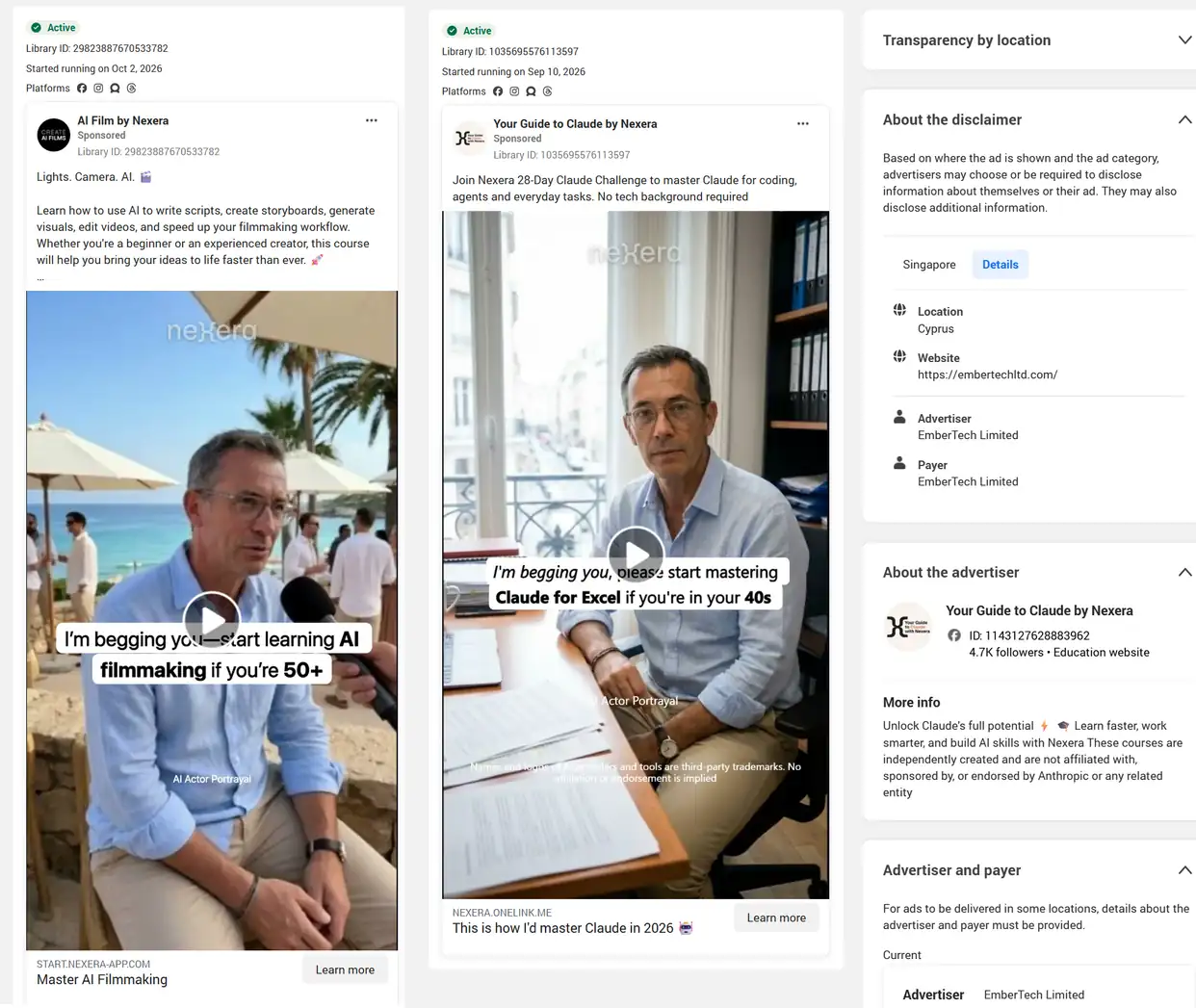
“I’m begging you” gives both ads the tone of personal advice. The age reference makes the invitation specific; the roadmap then turns a broad ambition into a sequence of things to learn. The office version starts with a recognizable work task. The beach version offers a creative possibility.
The shared feature is that progression: age-based appeal, brief presenter scene, structured program. It is visible in both videos without needing to assume their spoken scripts are identical.
For someone encountering either ad, the course arrives wrapped in a different situation. One looks like advice about office competence; the other looks like an invitation to filmmaking. The underlying selling logic remains close: AI is something you can learn through an organized path, with an outcome relevant to you.
The couple and the dragon share an audio track
Two short-drama ads offer an even clearer example of interchangeable parts.
In one version, a man and woman appear in a luxury interior. The on-screen pitch is “Create and Sell your Short Dramas.” In another, the imagery centers on a fantasy woman, a dragon and a city. Its text reads “Create AI Short Dramas.”
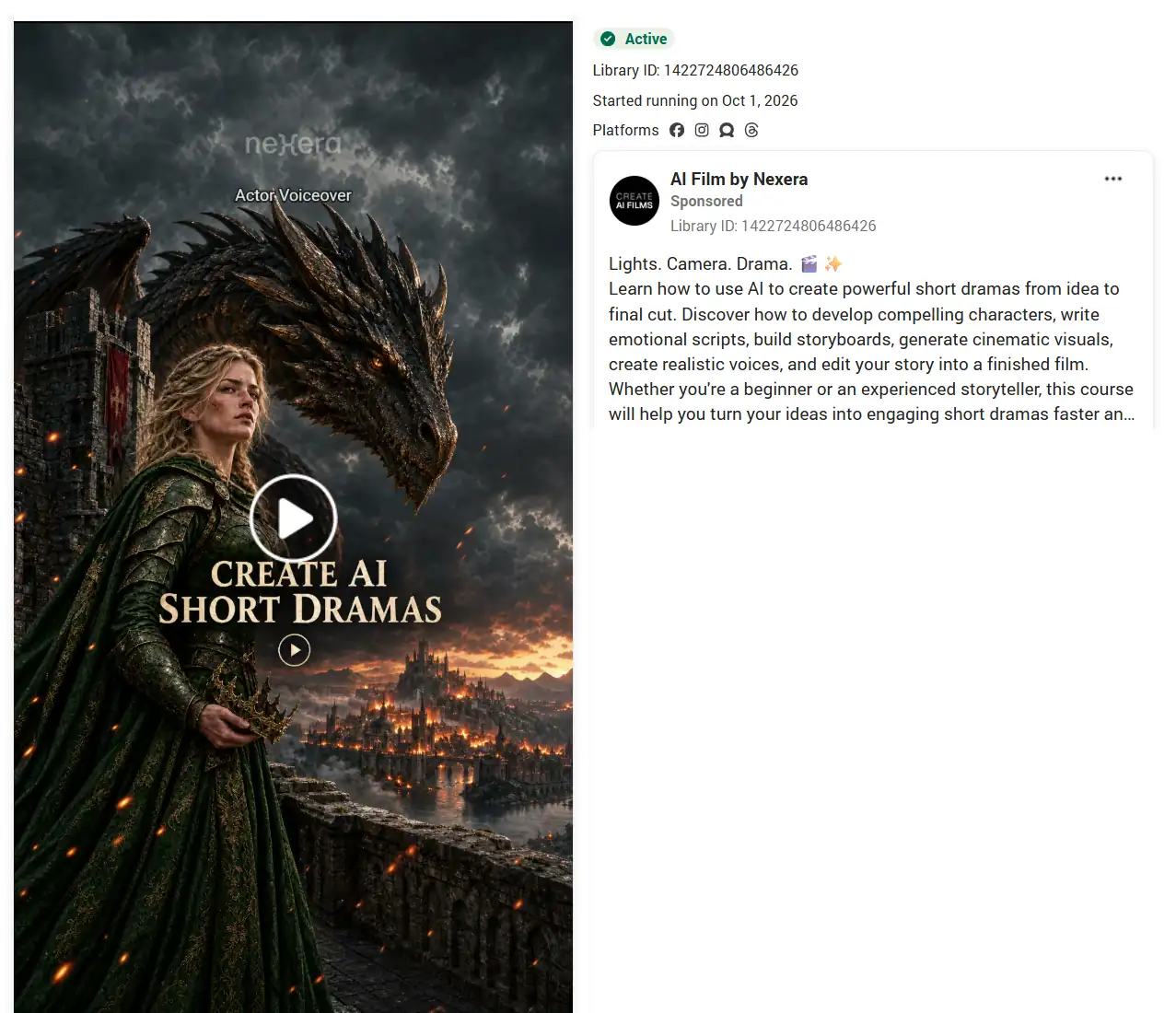
Both run for about 59 seconds. Their visuals are materially different, but their audio is identical.
This is more than two ads making a similar claim. The same audio track accompanies two distinct visual wrappers: a couple in an upscale setting in one, a fantasy scene in the other. Even the visible promise shifts slightly, with the first explicitly adding the prospect of selling the dramas.
There is no need to guess how those images were made to understand the reuse. The audio can remain in place while the visual setting and on-screen wording change. That makes the short-drama pair a particularly concrete example of what modular advertising looks like.
It does not tell us which version persuaded more people, or why Nexera chose these two treatments. The public evidence establishes the combination of reuse and variation, without supplying the advertiser’s testing plan.
The same media can appear under different ad records
Reuse also happens without a new visual wrapper.
A reviewed Claude video moves through a notebook opening, a conference-style presenter and a Claude playbook. Two Meta ad records serve the same media asset: one points toward a quiz, while the other uses an app-routing link.
That distinction matters when looking at the size of Nexera’s public advertising presence. A library record is an entry for an ad; it is not automatically a newly produced video. Nor does a separate record establish a separate campaign.
In the October 5–6, 2026 research snapshot, AdsUncovered documented 65 Meta ad IDs and 40 distinct Google creative IDs in the loaded samples. Those figures describe a bounded public footprint. They are not counts of unique videos or campaigns, and they are not a global census of Nexera’s advertising. They also reveal neither spending nor how often an individual sees the ads.
The examples explain more than the totals do. There are genuinely different executions, and there are repeated assets living under different records. Counting everything as a fresh production would blur that difference.
Some of the presenters are explicitly labeled AI actors
The AI component is supported by readable labels inside four reviewed creatives.
“AI Actor Portrayal” appears in the office-based Claude-for-Excel ad and the beach-based filmmaking ad that open this article. The same disclosure appears with the conference-style Claude presenter and with a studio or podcast-style presenter in an ad associated with AI Avatar Studio.
Some Nexera presenters are explicitly labeled as AI actor portrayals. That does not tell us who wrote the script, generated the voice, edited the video or ran the campaign.
The label is useful because it gives the viewer something firmer than an impression that a face looks synthetic. It also changes how to read the scene around that face. A desk, a microphone or an interview setting can frame a presenter as someone offering personal guidance, but the disclosed portrayal should not be mistaken for evidence of an ordinary customer’s experience.
These labels concern the presenter portrayals in those specific creatives. They do not establish that every Nexera presenter is an AI actor, or that an entire video was generated with AI. The short-drama ads, for example, carry “Actor Voiceover” wording, which by itself does not establish an AI-generated voice.
Nexera’s visible ad system therefore combines two findings with different implications: concrete reuse across media, and explicit AI-actor disclosures in some presenter scenes. Neither requires a claim that the whole operation runs automatically.
Different topics, different front doors
The variation extends to the names attached to the ads.
“Your Guide to Claude by Nexera” presents a tool-specific entry point. “AI Film by Nexera” frames the offer around filmmaking. Other observed identities include “AI Design by Nexera,” “AI Certificate by Nexera” and “AI Avatar Studio.”
Their creative choices reinforce those distinctions. A logistics-focused ad displays “AI Certificate for Logistics Managers,” alongside topics such as route planning and inventory flow. A design ad moves through drawings and plans before showing a learning roadmap. The films, office software and professional-skills pitches offer different reasons to stop and look.
These are observed identities within the Nexera ad-and-destination context. The names alone do not establish the ownership of every page or why each was created. What they do show is how a related ecosystem can present several topical entrances to a viewer.
The links provide another layer of variation. Several ads point to a Nexera quiz path. A separate Google-ad landing path and an English-language quiz URL showed the same basic opening: “Master AI in 2026,” followed by a question about previous use of AI tools.
That is a shared first screen, not proof that every subsequent journey is identical. A film ad and a workplace-software ad can reach a common intake without establishing what happens after the initial questions.
Other records use an app-routing link. In the reviewed desktop visit, that link led to the US App Store listing for Nexera. Routing on other devices or in other regions was not established.
For the person clicking, the opening promise may be very specific—Claude, films, logistics or design—while the destination initially presents a broader AI-learning offer. That is the visible connection between the themed wrappers and the front doors behind them.
Why a large creative pool can be useful
The ads demonstrate several ways to vary an offer: change the presenter, change the context, change the pictured outcome, or reuse a complete asset with a different destination. Modern ad platforms provide a setting in which a pool of alternatives can be useful.
Meta’s engineering description of ad retrieval explains how its system selects candidates from a large set of eligible ads before further ranking. A larger pool gives the system more candidates to consider. It does not guarantee that every additional version will improve results.
Google offers another illustration. Its responsive display documentation describes combining supplied assets, including images, headlines and descriptions, and adapting ads to available space. That is a general platform capability, not evidence that Nexera uses that particular ad type.
These mechanisms help explain the practical appeal of creative variety. An advertiser can supply different ways to present an offer rather than relying on one video to do every job. Nexera’s public examples show those alternatives in concrete form, from office guidance to beach interviews to fantasy scenes.
The libraries do not disclose Nexera’s campaign configuration, however. A visible collection of variations cannot identify the tools used to assemble it or establish whether the changes were planned as a particular experiment.
What the public view leaves out
An active ad record is not a performance report. An inactive one is not proof that the video failed. And encountering several related ads does not establish how frequently they reach any particular person or whether that person is being retargeted.
The public record leaves spending, conversions and profitability unresolved. It cannot tell us whether the couple beats the dragon, whether the office presenter outperforms the beach presenter, or whether either earns back the cost of distribution.
For viewers, the useful distinction is between a new-looking presentation and new evidence for the offer. A different face, setting or roadmap can make the pitch feel different while carrying familiar selling logic. Nexera’s ads give us concrete examples of that process. The libraries show the variations on display; the results remain inside the advertiser’s accounts.