
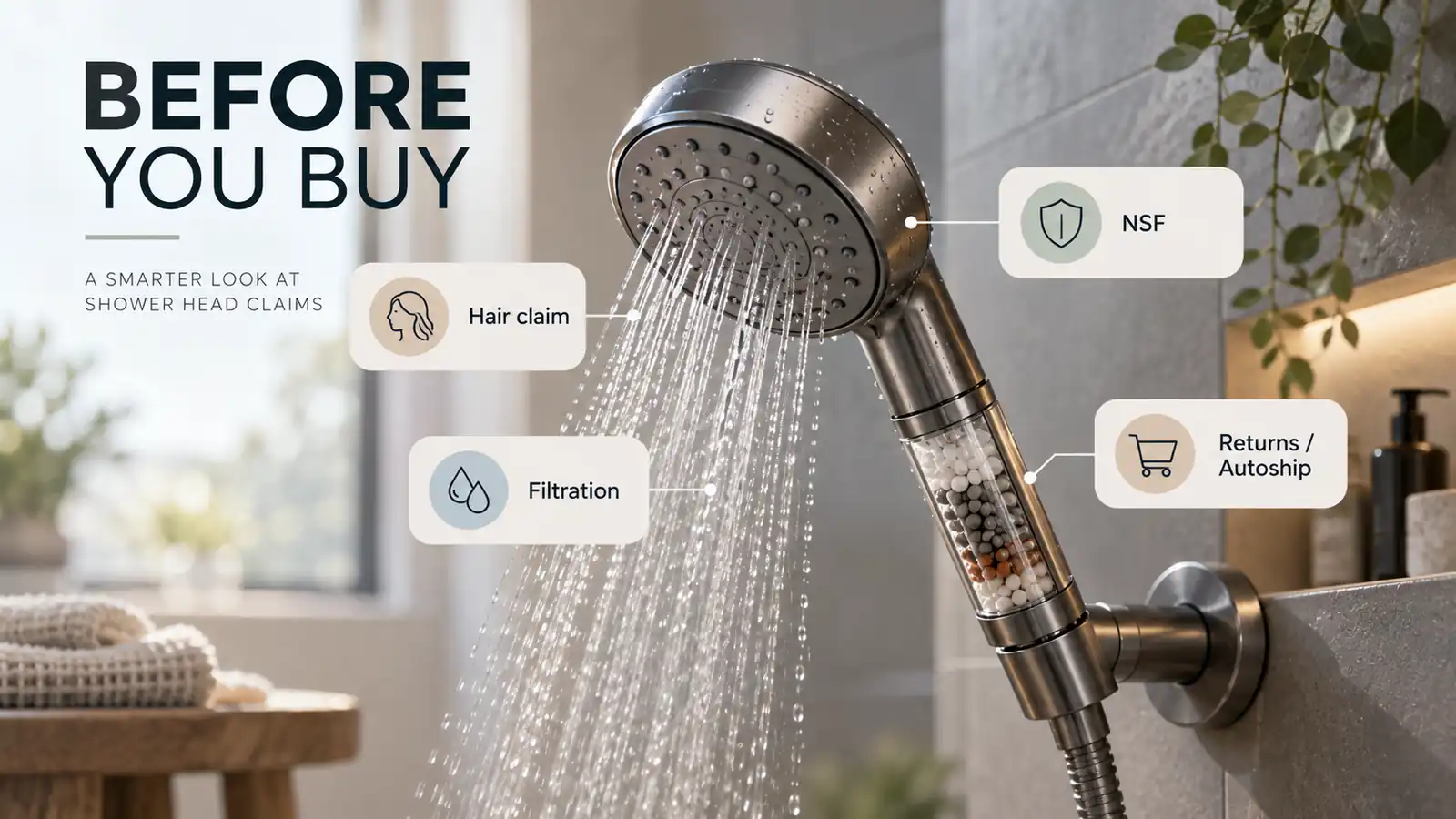
You may start looking at Eskiin because of a shower head. The marketing quickly gives you a much bigger problem to think about.
Eskiin’s homepage says its products can help “prevent hair loss.” One of the company’s long-form advertorials goes further, suggesting that what looks like hair loss may actually be breakage caused by hard water — “It’s not loss. It’s breakage. And it’s reversible.”
That is a powerful sales story: the water is damaging your hair, the damage may be mistaken for hair loss, and changing what comes out of the shower could help solve it. There is a plausible idea underneath part of that story. Researchers have studied whether hard water can affect hair fibers, and some laboratory work has found changes in tensile strength after exposure to hard water, while other studies have produced different results.
But none of that answers the question a buyer actually needs answered:
Does this Eskiin shower filter produce the specific outcome Eskiin is selling?
That is where the evidence gets much less simple.
The hair promise goes beyond “my hair feels softer”
A shower product can make your hair feel different without preventing hair loss. Those are not interchangeable outcomes.
Eskiin’s marketing sometimes blurs that distance. The company has published the broad claim “prevent hair loss,” while its hair-focused advertorial builds a narrative around hard water damaging hair and Eskiin filtration interrupting that process.
There is some relevant science behind the general idea that water chemistry can affect hair fibers. A 2018 laboratory study found reduced tensile strength in hair strands exposed to hard water under its test conditions, while an earlier study did not find a statistically significant difference in tensile strength. Neither study tested Eskiin.
More importantly, a laboratory result involving isolated hair fibers is not the same thing as showing that a particular shower filter prevents a person’s hair from falling out. For that claim, the evidence would have to reach much further: from the water problem, to what the Eskiin filter actually changes, to a measurable improvement in the relevant hair outcome.
We did not find a publicly available clinical study of an Eskiin product that completes that chain. That does not mean no evidence exists anywhere; it means the public material we found does not provide the kind of product-specific clinical evidence that a claim about preventing hair loss would normally call for.
Before the hair claim comes the filtration claim
For the larger beauty promise to work, the filter first has to do what the marketing says it does to the water. Here Eskiin uses some striking language.
Its wall-mounted shower head page says the product “blocks out 98.7% of the bad stuff.” The separate handheld page says it “Eliminates Chlorine.”
The first problem is that “bad stuff” is not a defined substance. A precise percentage sounds scientific, but it is only useful if you know what was measured. Removing 98.7% of one compound is different from removing 98.7% of chlorine, hardness, metals, disinfection byproducts or everything a customer might imagine the phrase covers.
Eskiin also sells different models, so evidence for one should not automatically be transferred to another. That becomes important when we look at the independent testing that is publicly available.
One independent test did not find the expected chlorine reduction
WaterFilterGuru’s Brian Campbell published a detailed test of an Eskiin wall-mounted shower head in September 2026. In that test, free chlorine measured 1.68 ppm before the filter and 1.79 ppm after it.
Campbell did not interpret the small increase as evidence that Eskiin was adding chlorine; he noted that normal variation or a defective unit could be possible explanations. His laboratory samples also did not show reductions in three detected disinfection byproducts, and hardness remained roughly unchanged.
That is meaningful evidence because it is an actual measurement of one Eskiin product under described conditions. In that test, the expected chlorine reduction was not observed.
But it is still one test of one wall-mounted unit, not every Eskiin cartridge, every revision or the handheld model. It also does not tell us what would happen across the full life of a replacement filter.
So the reasonable takeaway is not “Eskiin does not filter chlorine.”
It is narrower:
One independent test of the wall-mounted model did not show the chlorine reduction a buyer might expect from the broader filtration pitch.
A stronger public evidence package from Eskiin — with an identified laboratory, model, test protocol, incoming and outgoing concentrations and performance over the cartridge’s useful life — could answer that much more directly. The company says its products have been tested by third-party labs, but that complete model-specific documentation was not linked to the claims we reviewed.
A shower head can still feel good to use
None of this means someone cannot genuinely like the product. The Spruce had a positive experience with the handheld Eskiin model during its shower-head testing. After several weeks, the reviewer praised the spray and handling and reported that skin and hair felt softer.
That is useful information if you want to know what the shower head feels like in everyday use. It is not a chemical analysis of the water.
A person can prefer the spray, enjoy the shower and feel that their hair is softer without having measured chlorine reduction. Likewise, an independent water test can raise questions about filtration without telling us whether someone will enjoy using the shower head.
Those findings only appear contradictory if we ask them to prove the same thing.
A better shower experience is not the same claim as measured filtration, and measured filtration is not the same claim as preventing hair loss.
The NSF language adds another layer of credibility
Eskiin’s product pages also use NSF-related language. The wall-mounted page says the product “FAR exceeds NSF-177 certifications.” The handheld page says it is “Tested to meet NSF standards” and elsewhere uses similar “meets” wording.
To an ordinary shopper, those phrases can sound closely related to certification. They are not the same thing.
NSF itself made that distinction unusually relevant to Eskiin in December 2025, when it published a public notice concerning the Eskiin Handheld Filtered Showerhead. NSF said there had been unauthorized references to NSF certification and stated that Eskiin did not have products certified by NSF at that time.
That notice is about certification claims. It does not say the shower head failed a filtration test, and it does not say the product removes nothing.
The distinction matters because a product can be tested according to a standard, a company can say it meets or exceeds a standard, or a product can be certified by a certification body. Those claims require different proof.
For an actual NSF certification, there should be a verifiable certification status for the relevant product and scope. For a statement that a product was tested against a standard, the useful evidence is the test itself: what was tested, by whom and with what result.
NSF/ANSI 177, the shower-filtration standard referenced here, includes performance related to reducing free available chlorine along with material and construction requirements. It does not certify that a product prevents hair loss.
The acronym can add technical authority to a sales pitch, but it does not make every other claim around the product part of the certification.
Then the sales pitch removes some of the risk
Big promises are easier to consider when trying them sounds financially painless. That is why Eskiin’s money-back language matters to the story.
The company’s homepage promotes a “100% Money Back Guarantee.” More strikingly, the hair-focused advertorial tells buyers:
“We pay the return shipping. You’re out nothing.”
That is unusually clear wording. But the advertorial links to Eskiin’s published refund policy, and that policy says return shipping is deducted from the refund.
Advertorial: “We pay the return shipping. You’re out nothing.”
Published refund policy: return shipping is deducted from the refund.
Those two published messages do not line up. The policy also includes other return conditions, but the shipping point is enough to understand the issue: the advertorial tells the buyer that Eskiin pays return shipping, while the linked policy says the cost is deducted.
That does not establish that Eskiin never pays return shipping in practice or that a customer can never receive a full refund. We did not make a purchase and run an actual return through the system, and there could be circumstances or offer-specific handling that the public documents do not explain.
But the mismatch itself is real, and it matters because “You’re out nothing” is part of the persuasion. It lowers the perceived risk of testing the larger promises.
If the written terms may leave the customer paying return shipping, that is something worth knowing before the box arrives.
The lower price also starts an ongoing filter purchase
There is one more part of the offer that is easy to treat as a pricing detail but changes what the buyer is actually agreeing to. On the wall-mounted offer we reviewed, Eskiin listed the shower head at $115 with Autoship and $149 as a one-time purchase.
The Autoship option included replacement filters delivered every 90 days for $33. Eskiin’s separate replacement-filter page likewise listed the wall-mounted replacement at $33 with a subscription, compared with $36 as a one-time purchase.
There is nothing inherently unusual about a filtration product requiring replacement filters, and the more expensive one-time option was available. The important point is simpler:
The lower upfront price is part of a recurring filter relationship.
So a buyer comparing only $115 with $149 is not comparing two identical purchase structures. One starts with a lower price and continues with scheduled filter replacements.
That belongs in the same consumer check as the filtration and guarantee claims, because it answers a different version of the same question:
What am I actually buying when I accept the sales pitch?
What survives when each promise gets the right test?
The Eskiin story becomes much easier to understand when the claims are separated instead of bundled together.
Someone saying the shower feels better can support a claim about their experience. A water test can support a claim about what happened to particular substances under particular conditions. A certification record can support a claim about certification, while a clinical study can support a health outcome if it actually studied the relevant product and outcome. A refund policy, meanwhile, can tell you what the “risk-free” part of the purchase means after the marketing language is stripped away.
Those categories should not borrow credibility from one another.
A positive shower-head review does not prove hair-loss prevention. An NSF-related phrase does not turn into certification by implication. One unfavorable chlorine test does not settle the performance of an entire product line. And a 60-day guarantee does not become meaningless just because its terms are more complicated than the headline.
That is why the most useful question about Eskiin is not whether the shower head is simply “good,” “bad,” “legit” or a “scam.” The marketing makes a much larger promise than that.
It links the water in your shower to hair problems, presents filtration as the solution, adds technical language that can strengthen confidence, and then makes trying the product sound low-risk. Some parts of that story are easier to support than others.
And the further the promise moves from “this may make your shower feel nicer” toward “this will change your water and prevent a health or beauty problem,” the more specific the evidence needs to become.
That is the part worth checking before the sales pitch becomes the reason you buy.