

What this article covers
AdFection shows how targeted advertising became part of a spyware delivery chain. Citizen Lab linked ads purchased by Discover-Tech to infections on Al Jazeera devices, while Confiant documented ad code and staging without capturing the full exploit chain. The case explains why a click was unnecessary—and why an ad impression alone does not prove infection.
You can ignore a banner without stopping it from loading. That is the uncomfortable distinction at the center of AdFection, a case in which advertising infrastructure became part of a spyware operation.
In an investigation published on October 15, 2026, Citizen Lab linked targeted ads to spyware infections at Al Jazeera. Its evidence included network logs and a malicious Windows file recovered from a compromised device.
The researchers traced the operation to ads purchased by Discover-Tech, an Israeli ad-tech company. They describe a highly targeted attack that required no ad click. Discover-Tech’s ads formed part of a spyware delivery chain. Understanding that chain also explains why encountering one of its ads was not, by itself, proof of infection.
An ad can run before you click
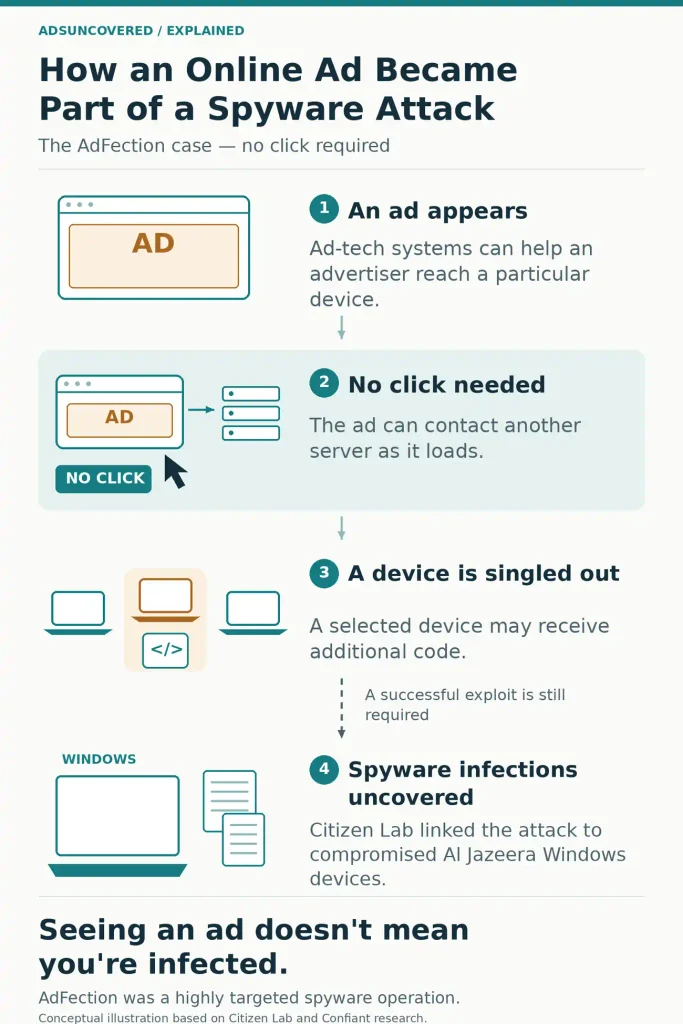
A display ad can contain more than the image and link you see. It can load scripts that make requests and collect information while the ad is being displayed. Clicking is a separate event.
The visible offer did not have to persuade the intended target to visit a landing page. Code associated with the ad could already be communicating with another server.
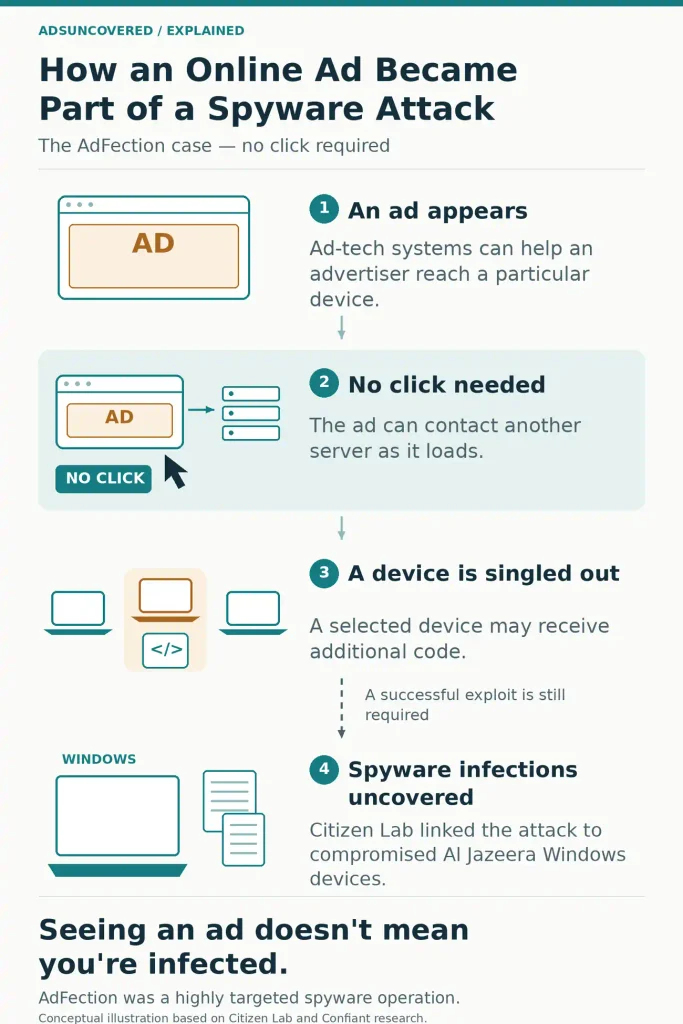
Programmatic advertising also provides ways to reach particular devices. An automated auction decides which buyer gets to show an ad, using signals that can include device identifiers and IP addresses. Those signals help advertisers recognize an audience; in the wrong hands, they can also help an operator recognize a surveillance target.
In Discover-Tech’s system, an ad could contact a server that decided whether to return additional code. That made the response selective. Two people encountering similar-looking advertising did not necessarily receive the same code.
Loading a script is not the same as installing spyware. A successful infection still requires an exploit to overcome the device’s security protections. The ad provides a route to the device; whether a later attack succeeds is a separate question.
The mechanism combines two capabilities: finding a particular recipient and sending that recipient code. That is why advertising infrastructure matters to this case.
What established the Al Jazeera infections
Citizen Lab’s account goes beyond demonstrating that an ad could load a script.
In the Al Jazeera incident, Citizen Lab says network logs showed infected devices contacting Discover-Tech infrastructure, then a server used to check the device, and finally servers used to control the spyware. A malicious Windows file recovered from one compromised device contained matching server information. Its characteristics helped the researchers attribute the operation to commercial spyware vendor Candiru with high confidence.
That combination supports Citizen Lab’s finding that targeted ads delivered spyware to compromised devices at Al Jazeera. It does not amount to a published recording of every step on every targeted device.
The report identifies at least 45 devices targeted in 2024 and 2025. It does not separately enumerate how many of those were successfully infected.
A parallel investigation by advertising security company Confiant adds another evidence layer. It analyzed ad code, device fingerprinting and encrypted communications used to prepare further code delivery. But Confiant explicitly says it did not capture a complete exploit chain in the wild.
Confiant’s work helps explain how the advertising machinery operated. The evidence of installed spyware at Al Jazeera comes from Citizen Lab’s incident investigation. Discover-Tech and Candiru did not respond to Citizen Lab’s requests for comment within its publication deadline.
Exposure is not infection
The advertising footprint was far larger than the documented Al Jazeera incident. Confiant estimates that Discover-Tech served roughly 10 million ad impressions a day. That is an estimate of advertising activity, not a daily infection count.
Several outcomes can sit behind an impression. A device may be exposed to an ad, have information collected for profiling, be selected for additional code, encounter an attempted exploit, or be successfully compromised. Evidence for one stage does not automatically establish the next.
Confiant’s observations also carry a useful warning about institutional networks: an ad reaching a government network does not identify a particular official as its target. The connection could belong to a guest or pass through a shared network exit.
The ABC’s response on October 23 illustrates the difference. The broadcaster said ads from the network appeared on a small number of its devices, but it found no signs of compromise. It was wiping devices still in service as a precaution.
The response illustrates why exposure warrants investigation without establishing the outcome of that investigation in advance.
What platform approval actually covered
Discover-Tech’s presence in established advertising systems raises another question: what reassurance did its status provide?
An archived Google Certified External Vendors list includes Discover-Tech as a demand-side platform. The same page says vendors undergo a business review and that Google does not verify or guarantee their technical implementation.
That is a narrower assurance than the word “certified” might suggest to a reader. As with Google-served display ads more generally, platform involvement does not settle every question about the advertiser or the code it supplies.
Google subsequently blocked Discover-Tech from its advertising platforms. In an October 23 response reported by CyberScoop, it said it had blocked individual malicious ads during the joint investigation and defended its audits and layered safeguards.
IAB Europe suspended Discover-Tech from the Global Vendor List of its Transparency & Consent Framework after an audit found policy violations. That was a compliance action within the framework, not an independent finding on every spyware allegation.
IAB Europe also disputed the researchers’ broader interpretation. It told CyberScoop that the findings showed potential misuse of web technologies rather than proving that advertising infrastructure was broken.
The findings expose a specific challenge for safeguards: a check of one response cannot establish what every selected recipient receives when code can change depending on the device loading it.
What “no click” changes for the reader
Avoiding suspicious clicks still helps against scams that need you to visit a page, enter information or download something. AdFection exposes a limit to that advice: the attack described by Citizen Lab did not depend on that decision.
It also exposes a limit to judging an ad by appearance. A plausible banner can accompany code whose behavior depends on who receives it. The person reading the page cannot inspect that selection process by looking at the creative.
This was a sophisticated operation aimed at selected targets. The documented Windows incident does not establish infections among mobile users exposed to the wider advertising activity, or tell us the infection risk of an ordinary ad impression.
AdFection shows why the click cannot be the only boundary we consider. Advertising machinery can help locate a selected device and become part of a spyware delivery chain before the user chooses whether to follow the offer.