You were not planning to buy another software tool.
Then the offer appears.
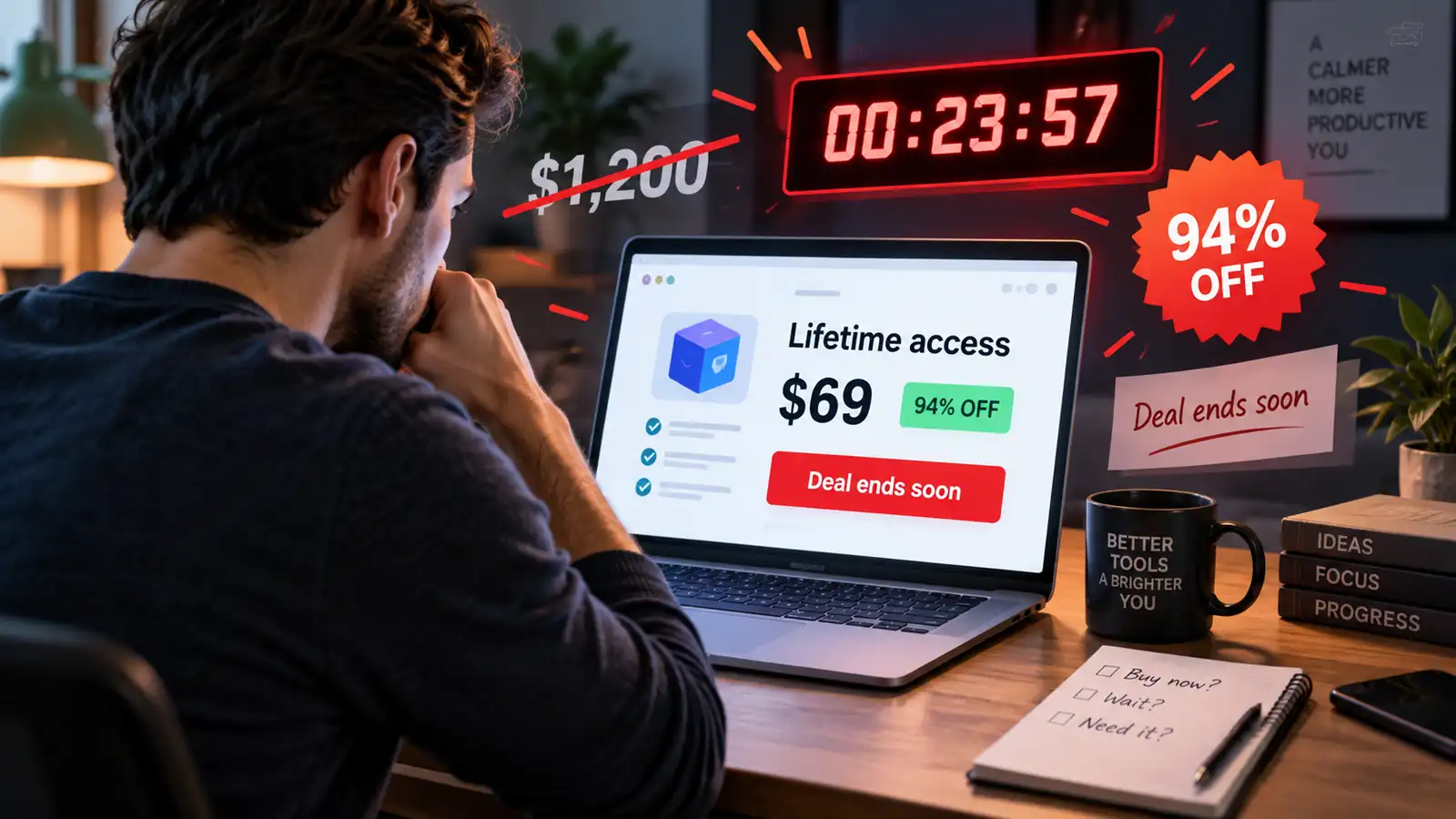
$69 instead of $1,196. 94% off. Lifetime access. Deal ends soon. 60-day refund.
That combination appears on the ZeroRank AI offer on AppSumo, along with multiple license tiers and a countdown.
Maybe the product is useful. Maybe $69 is a perfectly good price for it.
But notice what the offer has already done before you have figured that out.
The question is no longer just:
Do I need this product?
It can quickly become:
Am I going to lose a $1,000 bargain if I wait?
That is what makes lifetime deals interesting from an advertising perspective.
The pitch is not simply “buy this software.” It combines a large apparent saving, a one-time payment, freedom from another recurring subscription, the promise of long-term access and some form of deadline.
Each element is persuasive on its own.
Stack them together, and a product decision can start to feel like a deadline decision.
“Pay once” sells more than a discount
Subscriptions have become the default for a huge amount of software.
Email tools, design apps, cloud storage, AI products, productivity software — another useful service often means another monthly or annual charge quietly joining the collection.
Lifetime-deal marketing offers an appealing alternative:
Pay once. Stop thinking about the bill.
That is not our interpretation of the pitch. Sellers say it directly.
The WizCut lifetime offer, for example, uses “Lifetime Deal,” “Pay once, use forever” and “No recurring fees” on the same page.
The product costs $119 as a one-time payment.
That means the offer is selling two things at once.
One is access to the software.
The other is the feeling that this particular expense has been permanently removed from your future.
No renewal reminder. No annual price increase to think about. No subscription that you meant to cancel six months ago.
That emotional benefit is part of the pitch, not just the discount.
And it helps explain why lifetime offers can feel unusually easy to justify. You are not only comparing $119 with whatever the software might otherwise cost today. You are imagining all the future payments you supposedly will not have to make.
WizCut is also useful because its own page shows that a strong lifetime pitch and meaningful fine print can coexist.
It says lifetime updates are included, but also explains that expensive future features — transcription is one example it gives — may have separate pricing or limits.
So “pay once, use forever” can be true within a defined scope without meaning “every future thing this company ever builds will be free forever.”
That distinction becomes important later.
First, there is the number designed to make the deal look irresistible.
The crossed-out price changes what you compare
A price of $69 asks one simple question:
Is this product worth $69 to me?
A price of $69 next to a crossed-out $1,196 and a 94% discount asks something else.
The page invites you to see $69 not just as a price, but as $1,127 in apparent savings.
That is the power of a reference price. It gives you a number against which the current offer can look unusually small.
But before treating that displayed saving as money you are actually keeping in your pocket, there is a useful question to ask:
What does the larger number represent?
- Is it a previous selling price?
- A monthly subscription projected over several years?
- An annual plan?
- An MSRP?
- A more expensive tier?
- Or a different package with different limits?
With ZeroRank, the deal page presents $69 against $1,196 and labels the difference as 94% off.
What the accessible page does not make clear enough is exactly how that $1,196 baseline was constructed.
ZeroRank also has its own regular pricing page, but that does not give us enough evidence to say the crossed-out number is fake, inflated or wrong.
And we do not need to make that accusation to understand what the anchor does.
The larger number establishes the frame.
Instead of asking only whether this particular plan is worth $69, the buyer is encouraged to see the decision as an opportunity to capture an unusually large saving.
That can subtly change what is being evaluated.
The bargain starts competing with the product itself.
When the bargain becomes the product
This is where lifetime-deal marketing gets particularly effective.
Imagine two offers.
The first says:
Software license: $69.
The second says:
$1,196
$69
94% OFF
Lifetime access
Deal ends soon
Same checkout price.
Very different framing.
The second presentation stacks the apparent saving, lifetime access, subscription relief and a deadline around the same $69 purchase.
ZeroRank also pairs that stack with a refund period of up to 60 days, reducing some of the perceived risk around buying now.
The offer is doing more than simply presenting a product and a price.
The marketing changes the context in which the product and price are presented.
Then comes the deadline
A lifetime deal becomes much easier to postpone if it will still be there next week.
So urgency often completes the pitch.
- “Limited time.”
- “Ends soon.”
- A visible countdown.
- A dated sale window.
The basic message is the same:
You can think about the product, but not for too long.
That does not make the deadline fake.
A good example is software company Evinco.
Its 2025 Black Friday announcement explicitly ran from November 19 through midnight November 30. The company offered 20% off, described the product as a one-time purchase with a lifetime license and told customers to claim the discount before the sale ended.
That is a clearly dated promotion.
The deadline is part of the sales pitch, but there is no reason to pretend deadlines cannot be real.
ZeroRank’s page uses a “Deal ends in” countdown. Other lifetime offers use “limited time” wording without giving the same kind of clearly dated event window.
From the available evidence, we cannot say those timers reset or that the scarcity is false.
But we can say what a deadline does.
It turns “I’ll think about it later” into a choice that may mean losing the offer.
And that matters because time is useful when evaluating unfamiliar software.
You might compare alternatives.
Read the documentation.
Look at the normal pricing.
Check what “lifetime” covers.
Ask yourself whether you actually need the product.
A countdown does not prevent any of that.
It simply reminds you, every second, that thinking has a potential cost.
Lifetime does not mean unlimited everything
The word “lifetime” may be the strongest part of the pitch because it sounds enormous.
One payment.
Years of use.
Possibly decades.
But “lifetime” describes some kind of access. It does not automatically describe every limit inside that access.
ZeroRank makes this visible on the same marketplace page that advertises lifetime access.
Different tiers include different monthly amounts of answer credits, article generation, content optimization, research runs and workspaces. The deal terms also say future AI models may require an add-on or separate access.
The lifetime is therefore attached to a defined plan.
The consumption inside that plan is still metered.
Prismical’s AppSumo offer makes the distinction even easier to see.
Its lifetime plans include unlimited local transcription, but cloud transcription hours and AI credits are capped each month.
So a buyer can have lifetime access to Prismical without having unlimited lifetime consumption of every service Prismical provides.
That makes sense when software depends on ongoing infrastructure.
Cloud processing costs money to run. AI inference costs money. Storage, bandwidth and third-party services cost money.
A lifetime business model does not magically make those costs disappear.
And again, limits are not automatically a problem.
The risk is that the headline word lifetime does much of the sales work while the limits receive less attention.
WizCut handles that tension relatively clearly: existing functionality and lifetime updates are part of the offer, while some expensive future features may have separate pricing or limits.
That is useful fine print because it answers a question the phrase “pay once, use forever” cannot answer by itself.
Remove the countdown: would you still buy it?
There is a simple way to make a lifetime offer easier to evaluate.
Mentally break the sales page.
- Remove the countdown.
- Delete the 94% badge.
- Hide the crossed-out price.
- Ignore “last chance.”
Now imagine that the page simply says:
This software costs $69 once. Here is what you get.
Would you still buy it?
That question does not tell you whether every lifetime deal is good or bad.
It does something more useful: it puts the product back at the center of the decision.
- Do you actually need what it does?
- Which features are included?
- Which limits remain?
- What exactly receives lifetime access?
- Are cloud usage or AI credits capped?
- Are updates included?
- What does the reference price actually represent?
- And how long would you realistically use the product?
You can still conclude that the deal is excellent.
In fact, if the product makes sense after the promotional machinery has been mentally removed, the discount becomes a bonus rather than the reason for buying.
That is a much stronger position to buy from.
A lifetime deal without the pressure
Lifetime pricing does not require a dramatic countdown, a huge crossed-out price or a 90%-off badge.
Launch UI is a useful contrast.
Its pricing page currently presents a $99 one-time price with lifetime access, free updates and no recurring fees. It explains what is included and also offers a separate team tier.
There is no spectacular anchor price needed to make the offer understandable.
No countdown is required to explain why the company thinks $99 is worth paying.
The page even explicitly says “no false scarcity, no fake discounts.”
That does not guarantee that Launch UI will exist forever, and it does not automatically make the product a good purchase for everyone.
It simply shows that the lifetime model and the lifetime-deal pitch are two different things.
A seller can say:
Pay once and keep access.
Or it can say:
Pay once, save 94%, escape subscriptions forever, and decide before the clock reaches zero.
Both may lead to a lifetime license.
Only one turns the pricing model into a small event.
A good deal and a good sales pitch are not the same thing
Lifetime deals can be genuinely useful.
If you expect to use a product for years, a reasonable one-time price can beat recurring payments by a wide margin.
The model itself is not the problem.
But the strongest lifetime-deal marketing does something clever before you have answered whether the product fits your life.
It gives you a giant saving to protect.
A subscription to escape.
A lifetime of value to imagine.
And a deadline before all of it supposedly disappears.
That combination can turn “Do I need this?” into “Will I regret missing this?”
So when the next lifetime deal appears, try one small experiment.
Ignore the countdown.
Ignore the percentage.
Ignore the crossed-out price.
Then look at the product, the limits and the one-time cost that remains.
Would you still buy it if the deal were available tomorrow?
If the answer is yes, you may have found a good lifetime deal.
If the answer changes when the clock disappears, you may have discovered which part of the offer was really doing the selling.