What this article covers
Puma’s 2010 Journey of Football commercial connects street games, professional matches and supporters through a carefully constructed portrait of football culture. This analysis examines its scripted spontaneity, Gnarls Barkley song credit, visible Puma products and closing Love Equals Football message, using the supplied 90-second video and documented production sources.
A flag fills the opening image. A man carefully paints his face. Supporters gather around a team bus, and players stand with hands over their chests. Before the commercial settles into football action, it shows the preparation and gestures around the game. Puma’s idea begins there: football is something people inhabit, rather than something they only watch.
The commercial is Puma’s “Journey of Football,” part of its Love = Football campaign around the 2010 World Cup in South Africa. And the song—the answer for anyone who remembers the commercial mainly through its soundtrack—is “Going On” by Gnarls Barkley. That credit is supported by a contemporary announcement from music-rights consultancy GreenLight, which said it cleared the recording and publishing rights for Puma’s campaign.
Its most interesting creative choice becomes clearer through a production detail. On his directing portfolio, Gui Borchert says the scenes were scripted, then captured in a vérité style to make them feel immediate. The apparent spontaneity was a construction. That does not invalidate the film’s affection for football; it gives us a more useful way to examine how the ad makes that affection visible.
Which Puma commercial is this?
Puma’s official upload calls the film “Journey of Football (EXCLUSIVE ONLINE VERSION).” The player lists a 90-second running time, matching the approximate length of the copy reviewed here. Borchert also presents a 90-second version, while contemporary German trade coverage describes a one-minute television spot. Those are reasons to identify the edition being discussed, rather than assume every remembered broadcast contained precisely the same edit.
The campaign was made by Syrup. Creative director and writer Mike Spiegel’s portfolio places the TV film within a wider idea that also appeared on stickers, stencils, outdoor advertising and online material. “Love = Football” was a campaign platform, rather than simply another name for this particular video.
That distinction also prevents a common archival mix-up. A shared slogan does not make every Puma football advertisement from the period the same commercial. This retrospective concerns “Journey of Football,” not a compilation of everything Puma made around the tournament.
Creator upload linked from Gui Borchert’s directing portfolio. Available editions may differ; the visual analysis here uses a supplied 90-second copy.
Making football feel bigger than the match
The film moves among street games, children playing, training sessions, professional match footage and supporters. These are connected through repeated actions: controlling a ball, running, watching and celebrating. The settings change, but participation remains recognizable.
One particularly useful edit comes a little past halfway. A professional player strikes a ball in a stadium; the film then cuts to a child at a simple wooden goal. It is not a literal pass between the two scenes. The juxtaposition gives a professional match and a children’s game a shared visual language. The scale changes without making the smaller game feel like an afterthought.
That relationship matters more than a collection of spectacular skills would. Puma can appear in the world of elite competition while keeping ordinary play within the same story. A child does not need a stadium for the next kick to matter.
The close views of faces and bodies help keep this idea concrete. Early face painting makes allegiance something a person does. Later, tightly framed supporters, a child riding on someone’s shoulders and people crowded onto vehicles give support a physical presence. Football occupies streets, clothing and bodies as well as pitches.
For an equipment brand, this is a useful foundation. The clothing is being worn inside the activity the company wants to be associated with. Puma marks appear on shirts and a ball, while footwear also enters the frame, rather than waiting for the final logo to introduce the advertiser.
That establishes a creative connection, not a sales result. The film gives sporting products a recognizable place in football culture. Whether it persuaded anyone to buy them would require different evidence.
The spontaneity was designed
Borchert’s account makes the apparent looseness more interesting. He describes scripted scenes recorded with crews in Ghana and Ivory Coast, and credits co-direction with Jakob Daschek and cinematography by Max Goldman. These are production details from a participant, rather than an independent account of audience response.
For a viewer, the important distinction is between a scene that feels encountered and one that announces itself as a demonstration. A conventional demonstration asks you to look at what a product can do. Here, face painting, street play and celebrations invite you to notice what people are doing, while branded clothing sits inside that activity.
The closeness helps. A low viewpoint looking toward people in shirts gives their gestures scale. A crowd with arms raised leaves relatively little empty space for detached observation. The camera’s position makes the human activity the image’s organizing feature.
The critical question is not whether scripting makes those images worthless. Advertising regularly arranges performances and situations. It is whether the arrangement produces an observation worth attending to. Across the film, the useful observation is that football identity extends beyond the moment a player strikes a ball.
The limitation is equally clear: a selected, scripted set of images cannot stand in for the experience of an entire continent. The commercial offers a brand’s portrait of football culture. It is not a representative survey of African life.
Why “Going On” matters
The music credit is unusually well supported for an older commercial. GreenLight’s June 2010 announcement describes licensing the song for worldwide television and Internet advertising, with the campaign already running from March. That establishes the soundtrack’s commercial use without depending on a viewer’s recollection or an old forum answer.
Choosing a recognizable recording gives the advertisement another route into memory. Someone may remember a tune before a campaign name, or look for the song after forgetting the advertiser. That is a useful creative possibility, though it also exposes a branding problem: affection for the recording does not automatically become affection for Puma.
The title “Going On” also sits comfortably beside the idea of a journey. That is an interpretive connection, not a claim that every shot illustrates a lyric. The licensing record establishes a deliberate music choice; it does not establish how much of the commercial’s appeal came from the song.
What makes the idea belong to Puma?
Puma’s presence in African football gives the campaign a commercial reason to choose this territory. Contemporary trade reporting describes its relationships with African national teams. The film’s branded kit therefore connects a wider cultural claim with an existing sporting association.
That connection is stronger than adding a logo to an unrelated uplifting story. But it is not exclusive ownership of the feeling being presented. Other football brands could also celebrate supporters, informal games and national allegiances. Puma’s task is to make those shared ingredients feel consistent with its own place in the sport.
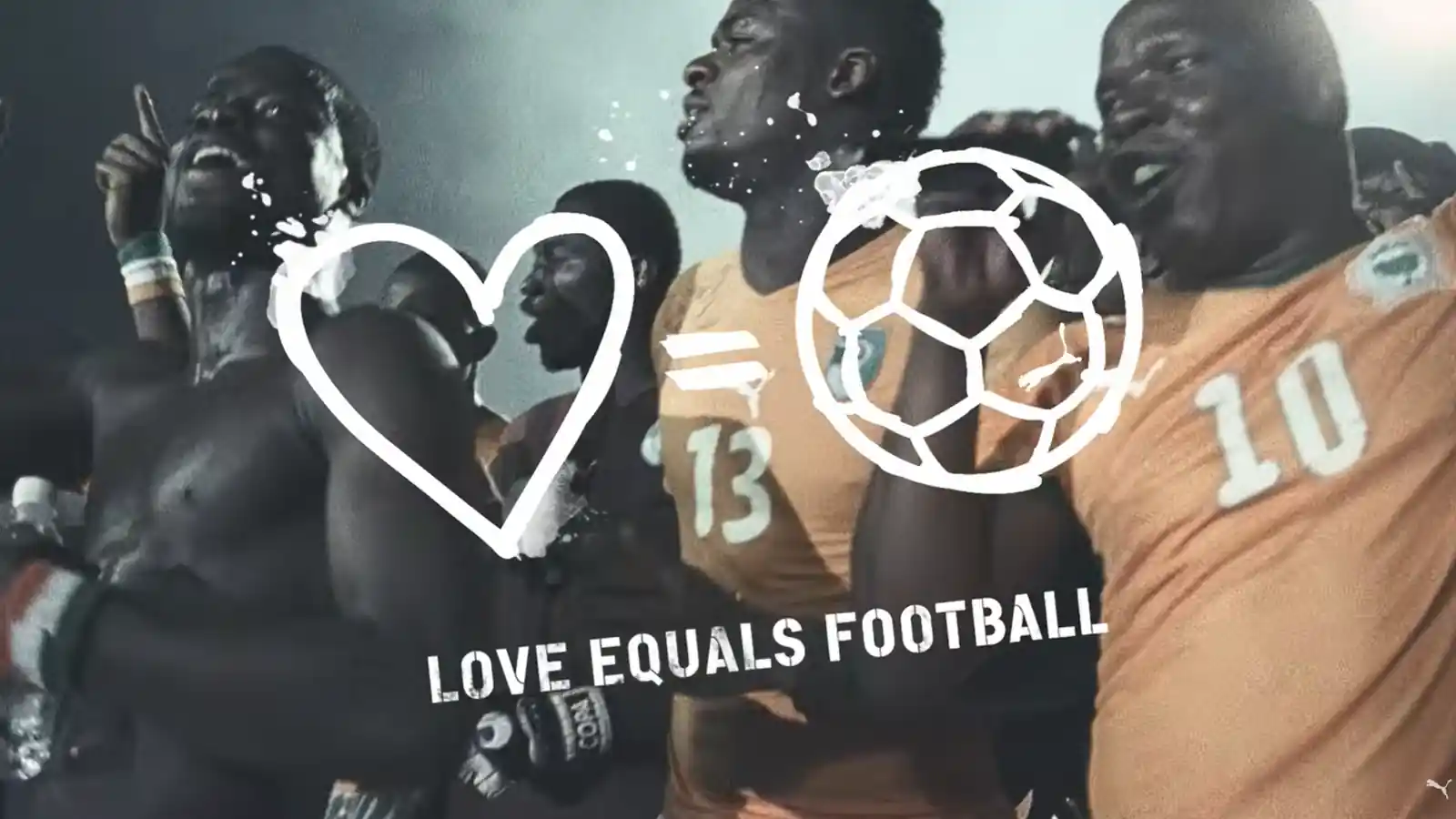
The ending makes that proposition explicit. A white heart, equals sign and football appear over a group of players, accompanied by the words “Love Equals Football.” An orange end card follows with the Puma name, a map of Africa and pumafootball.com. The website gives the film a destination, although it makes no specific purchase offer. The campaign reduces its varied scenes to one compact equation. As with the brand-and-product questions in our Halloween campaign analysis, the useful test is what the execution makes the brand contribute—not simply whether the subject is appealing.
“Journey of Football” offers a particularly clear answer: branded sporting clothing belongs within a world in which people play, support and express allegiance. Its strongest quality is the way the edit connects those human actions across different settings. Its weakness is the broadness of the promise. Love of football is easy for a sportswear company to claim; making that claim feel observed takes craft.
The production account reveals how deliberate that craft was. A film designed to feel spontaneous is a more interesting achievement to examine than a vague assertion that a brand captured the authentic spirit of a continent.