What this article covers
Google says information from Gmail or Google Photos that you choose to connect to Search may also be used for ads. This article explains what that permission means, why advertisers do not get access to your inbox, and how app connections differ from ad personalization controls.
Letting Google Search use information from Gmail or Photos can make its answers more useful. It can also change what you are allowing Google to use for advertising.
The answer is yes, potentially: Google says information from apps you choose to connect to Search may also be used for ads, depending on your settings. It says the connection does not give advertisers access to your inbox or photo library.
This is an optional connection. Having a Gmail account does not, by itself, mean you have agreed to let Search use it this way. The choice is whether to open that additional source of information to Search, with the uses Google describes attached to it. That is the permission to look for when considering Personal Intelligence.
Those two statements can both be true. Google says it can use information from connected apps to help choose ads without giving advertisers access to your inbox or photo library. That is the advertising consequence to understand before connecting.
The useful part – and the advertising part
Personal Intelligence is Google’s name for features that make its help more personal. In Search, connecting Gmail or Photos can give it relevant background you would otherwise have to explain yourself.
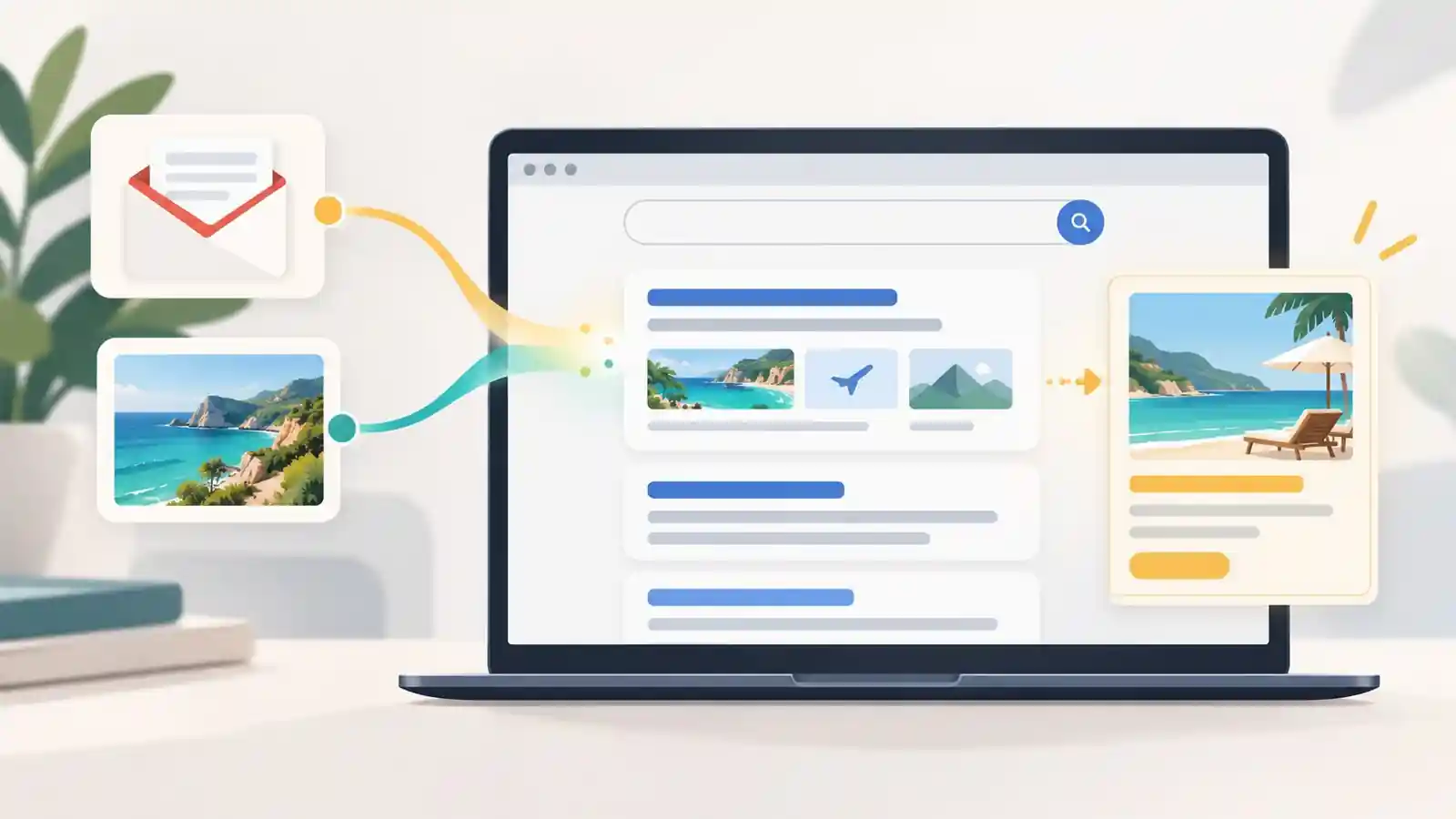
Take a hotel confirmation in Gmail. In Google’s travel example, a connection lets Search take account of a booking when suggesting things to do nearby. It can start with where you are actually staying.
That is a recognizable convenience. You are trying to plan a trip, and the relevant information is already in an email. Letting Search use it can save you from finding the message and typing the details into a question.
The additional use is advertising. Google says some information made available through these optional connections can also help personalize ads. A permission that makes an answer more useful can therefore have a commercial purpose too.
Google changed its privacy policy on October 16, 2026. It had excluded Gmail and Photos content from personalized ads. It now makes an exception when you choose to share data with other Google services that support personalized ads. That day, Search Engine Land reported the start of an ad test for AI Mode users with connected apps. This does not establish that all eligible users began receiving those ads.
The hotel example shows how the useful part works. It does not establish that a particular reservation produced a particular ad, and a personalized suggestion is not automatically a paid placement.
What Google means by “not directly”
Google says ads will not be based directly on your Gmail inbox or Photos library. Read on, though, and the same Search help page explains that information drawn from those apps may be used to show ads.
It describes shortened versions of relevant content, pieces taken from it and conclusions drawn from it. These are ways of using information from connected content; they can still carry personal details.
For you, the practical point is that details from a connected app can still have an advertising use.
A shortened version of an email can still say something personal. Information does not become anonymous simply because it has been summarized. Equally, Google’s explanation does not support saying that every message in every Gmail account is now automatically used to choose ads.
Google’s Photos guidance makes the cross-service distinction too: when you connect Photos to another service, that service’s rules and controls govern how it processes the information. The fact that information started in a private app does not, by itself, settle what Search can do with information you allow it to use.
Can advertisers read your email?
Google’s answer is no: connecting these apps to Search does not give advertisers access to your inbox or Photos library.
In its explanation of the advertising business, Google describes selling opportunities to show ads and providing advertisers with reports. The advertiser benefits from reaching people; it does not need to open their email to benefit from Google’s ability to select an ad.
That separation explains why the access question cannot answer the whole advertising question. You could reasonably care about Google using connected information for ad personalization even when no advertiser gets to browse the original material.
Google also says sensitive categories, such as health, religion and sexual orientation, are excluded from personalized ad targeting. Connecting an app is not described as permission to ignore those restrictions.
Two settings, two decisions
If the advertising use changes how you feel about connecting, there are two places to look.
The connected-app controls in Search let you manage whether Gmail or Photos is connected. My Ad Center separately controls personalized ads. Turning ad personalization off does not disconnect the apps.
Google says that with personalized ads off, it will not use information and activity saved to your Google account, or your My Ad Center choices, to show ads. Ads can still be selected using general factors such as the subject of what you are viewing. The setting does not make Search ad-free.
It helps to decide what you want to change first. To stop the app connection, manage the connection. To change Google’s use of saved account information for advertising, check the ad-personalization control. One setting should not be treated as a substitute for the other.
You also need to check which Google product you are using: the Gemini Apps Privacy Hub currently says Gemini Apps chats are not used to show ads, a different statement from Search’s connected-app disclosure.
Availability depends on your account and region, so simply having Gmail does not mean this connection is available or already enabled.
The decision to connect is a choice about what Search can do with personal context. Google's promised benefit is help that fits your life more closely. Its disclosed potential use includes advertising. Both belong in the decision — even when advertisers cannot open your inbox.