What this article covers
Heineken’s Pubscription turns the familiar act of browsing for something to watch into a way to choose a pub. This article examines how the campaign film, Fire TV interface and weekly drink voucher work together—and where the idea stops short of proving that people will actually go out more often.
Two men exchange serious looks. A bartender polishes a Heineken glass. Green title cards promise the kind of entertainment that apparently deserves a dramatic autumn launch.
Then the view widens to the men sitting together at a pub table, gesturing and smiling. The title appears: “Pubs.”
Heineken’s Pubscription gives an ordinary night out the treatment of a major entertainment release. The joke leads into a real promotion: a free Pubscription membership, piloted in the UK with Amazon, that applies the browsing logic of streaming to participating pubs and adds vouchers for a drink.
Announced by Heineken on October 20, the Fire TV experience is designed to help adults choose a venue, invite friends and redeem a weekly voucher for a Heineken or Heineken 0.0. Its most interesting move is making a pub look like a choice you might enjoy browsing from the couch.
The question is how well that invitation survives the journey from an entertaining ad to an actual evening out.
A trailer for the pub
The Heineken Pubscription commercial gives familiar pub moments an unusually serious introduction. Close-ups isolate expressions from their surroundings. The bartender polishing a branded glass becomes part of the anticipation. Between these scenes, green cards announce the arrival of “the original entertainment.”
There are glimpses of dancing and men watching something intently, too. The film gathers different kinds of anticipation under the same promise, giving the pub the range of an entertainment offering before explaining the service.
The return to the two men supplies the clearest payoff. In close-up, their expressions invite a dramatic reading. In the wider view, gestures and a smile put them back into an ordinary social setting. The pub has provided the entertainment all along.
That makes the opening a useful introduction to the product idea. It asks viewers to think of a venue as something worth choosing for the experience it offers. The catalog that follows has a reason to exist beyond the pun in its name.
Heineken also gives itself a place in that world early. The glass, bottles and bar branding establish the connection before the service receives its full introduction. By the time the offer arrives, the beer already belongs to the setting.
Turning places into titles
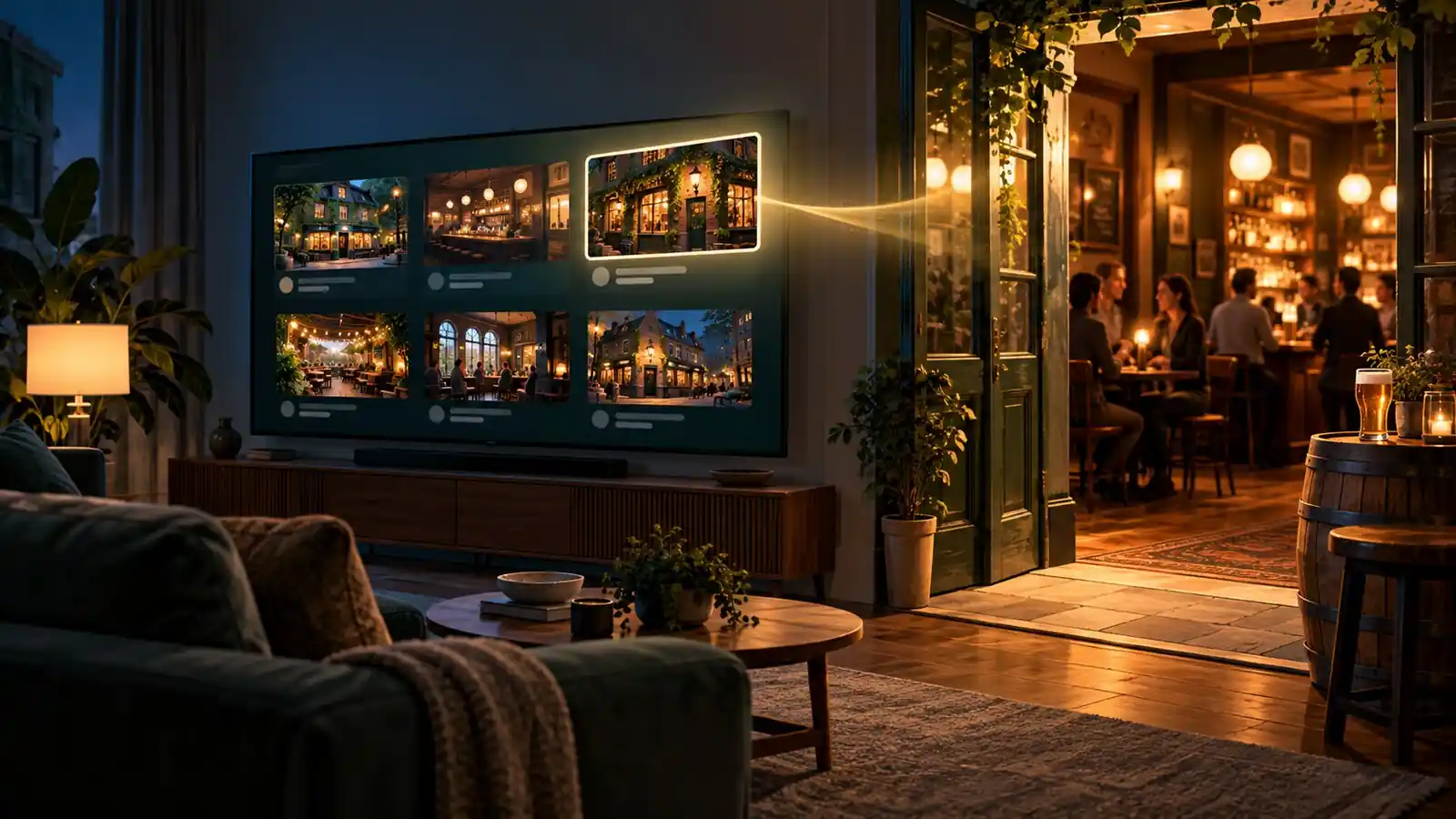
Pubscription’s second creative move appears in the demonstration of its interface. Rows of venue cards divide pubs into categories such as sports, classic and music. Each place gets a distinctive title treatment and a picture that suggests the evening on offer.
Selecting The Waverley Arms brings up a large image, a description, a button to explore further and a row of other suggestions. The familiar question of what to watch becomes a question of where to go.
This is where the streaming comparison earns its place. A conventional pub listing can tell you where a venue is. The film’s presentation also tries to make you imagine being there: the company, the atmosphere, the kind of evening. Browsing becomes part of the invitation.
There is a detail worth keeping in view. The interface sequence carries an AI-generated label, and Heineken’s platform says its participating-pub images were created using AI. The polished catalog should be read as a promotional presentation of the venues; its pictures do not establish exactly what a place will look like when you arrive.
The film shows the intended appeal of that presentation. It does not establish how useful the recommendations will be for a particular person, or how smoothly the live service works.
The pint gives the idea somewhere to go
The offer adds a practical reason to follow through. Under the promotion’s terms, members receive four vouchers per four-week period, with one usable in each specified week. Unused vouchers expire. The available drinks include Heineken Original and Heineken 0.0.
That weekly cadence gives the subscription language a purpose: the offer creates a recurring opportunity to visit. Whether it creates a lasting habit is a separate question, for which the materials reviewed provide no results.
The voucher works alongside the film’s invitation. Someone may like the idea of a particular pub and still need a reason to choose it this week. A drink offer supplies one. Its role feels coherent because the film has already presented the venue and the social occasion as desirable.
There are still steps between the couch and the bar. The documented process involves registration, selecting a participating venue and activating the voucher on a phone at the pub. It is a limited promotion for UK residents aged 18 and over, with redemption at participating pubs in England, scheduled to end January 6, 2027, or earlier once 15,000 vouchers have been redeemed.
Those boundaries keep the pitch in proportion. Pubscription offers a way to choose and a reason to try. Friends still have to be available, and someone still has to suggest a time.
The screen can come with you
The ending makes the campaign more interesting than a general appeal to spend less time with technology. A group in a pub watches sport together, with raised arms and bottles in view. A screen remains part of the evening. What changes is the company around it.
That is a persuasive choice for a campaign delivered through television. Heineken uses the entertainment people already enjoy to suggest a different setting for enjoying it. The pub offers shared anticipation and a place to react together.
The closing line, “Social networking since 1873,” gives that proposition a clear brand signature. It also places the new service inside a familiar role for beer advertising: associating the product with time spent together.
Pubscription’s creative strength is the continuity between its parts. The film makes the pub look worth choosing; the interface turns choosing into an inviting ritual; the voucher gives the choice a small, immediate reward. The material reviewed for this article does not establish whether that sequence has produced additional visits or sales. As an advertising idea, though, it gives Heineken a plausible role in the decision about where the evening happens.
Related reading: Halloween ads 2026: The ideas behind Fanta, Twix, Rivian and Pringles