For a while, YouTube seemed determined to teach us how badly we were apparently talking to other human beings.
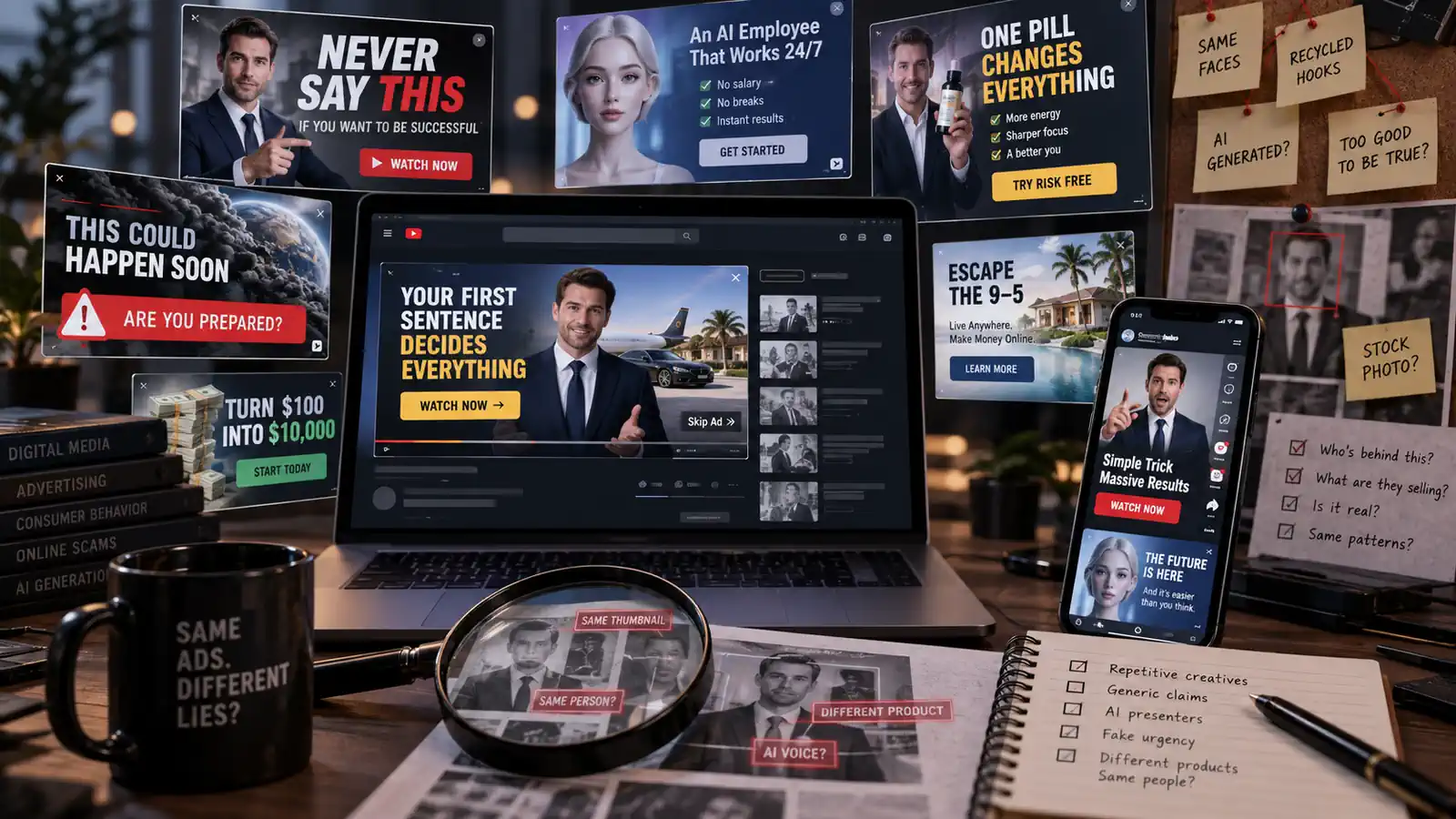
“Never start a conversation with this…”
“Never say these three words…”
“Your first sentence decides everything.”
Then there were the people who had supposedly spent 20 years coaching CEOs and billionaires and were now ready to reveal the five things the rest of us had somehow missed.
The format became familiar. A very serious presenter. A modern office, sometimes an expensive car. An impressive-sounding credential or life story. A warning delivered as if one wrong sentence, habit or decision could quietly ruin your relationships, confidence, health or finances.
Occasionally, the presenter looked so polished that another question came to mind: is this even a real person?
Mostly, the ads were irritating. Some were funny in ways they probably did not intend to be.
But after seeing enough of them, irritation turned into curiosity.
What is actually behind these ads?
That is where AdsUncovered started.
It’s not really about annoying ads
There have always been bad ads. Being irritating is not exactly a new invention.
What has changed is how easy it has become to create an extremely convincing impression in a very short time.
An ad can feature a supposed expert, a testimonial that is difficult to verify, artificial urgency, dramatic claims or a polished presenter who may be AI-generated. Celebrity images and voices can be manipulated. A cheap introductory offer may lead to a recurring subscription that becomes much more important than the price shown in the ad.
Some ads lead to perfectly legitimate products marketed badly. Some lead to businesses whose practices deserve more scrutiny. And some lead to suspicious websites, deceptive offers or outright scams.
Those things should not be treated as if they are all the same.
AI adds another layer to this. It can make advertising faster and cheaper to produce, including presenters, voices and endless variations of the same creative. There is nothing inherently wrong with that. A legitimate company using an AI presenter is still a legitimate company.
The problem is that the same tools are available to people selling much less legitimate things. Looking professional has never guaranteed that an offer is trustworthy, and AI makes professional-looking material easier to produce than ever.
The interesting part starts after the click
We are not especially interested in building a website that points at strange ads and says, “Look how stupid this is.”
That might be entertaining for a few minutes, but it does not answer the useful questions.
When an ad catches our attention, we want to follow it.
Who is actually selling the product? Is there a real company behind it? What does the service do once you get past the advertising language? What does it cost, and is that the full price or just the beginning of a subscription?
If there is a discounted trial, what happens when it ends? How does cancellation work? Can you get a refund?
Then there is the customer side. Are people generally happy with what they bought, or do the same complaints keep appearing? Is everyone complaining about the product itself, or about billing, renewals, refunds or difficulty cancelling?
Places such as Reddit, Trustpilot and app stores can be useful here, but a complaint is still a complaint, not automatically a proven fact. Patterns matter more than one angry review.
What we really want to know is whether the reality behind the product matches the story told in the ad.
Sometimes it probably will.
Sometimes it will not.
A terrible ad can still sell a real product
This distinction matters to us because it is easy to go too far in either direction.
A ridiculous ad can promote a completely legitimate product.
A useful app can have obnoxious marketing. A real business can rely on aggressive sales tactics. A subscription service can have many satisfied customers while still making its renewal terms harder to understand than they should be.
At the same time, a beautiful website, confident presenter and professional video do not prove very much either.
So AdsUncovered is not based on the idea that strange advertising equals fraud.
There is a difference between an annoying ad, aggressive marketing, misleading claims, questionable business practices and an actual scam. One of the reasons for creating this site is to try to work out where a particular case falls.
And sometimes the answer may simply be: the product looks legitimate, but the ad is awful.
That is a perfectly useful conclusion too.
What we hope will be useful
A large part of AdsUncovered will be investigations into individual products, companies and services that appear in online ads.
Some will be heavily promoted apps or subscription services. Others may involve AI presenters, questionable experts, strange endorsements, exaggerated claims, suspicious websites or ads that suddenly seem to follow everyone around the internet.
But there is another side to the site that matters just as much.
Sometimes you do not care who made an annoying ad. You just want to stop seeing it.
Sometimes you want to know how to change your ad preferences, report a misleading or suspected scam ad, or check an unfamiliar website before entering your payment details.
And sometimes you have already paid and discovered a recurring charge you were not expecting. At that point, finding the real cancellation or refund information is considerably more useful than another lecture about online advertising.
We want AdsUncovered to help with those situations too.
Why AdsUncovered?
The name came from the same basic idea as the site.
The advertisement is usually only the surface.
Underneath it is a company, a product, a business model, a price, perhaps a subscription, a set of claims and a collection of customer experiences. Sometimes there is nothing especially alarming there. Sometimes there is plenty worth examining.
We started looking because we were tired of seeing the same ridiculous ads.
We kept looking because the ads turned out to be the least interesting part.
So when something follows you around YouTube, Instagram or somewhere else online and you eventually find yourself wondering:
What is this thing — and can I trust it?
That is the question AdsUncovered is here to investigate.