
What this article covers
Antonio Banderas tries to end a relationship with his lunch. This analysis examines the Food Gang’s character design, the physical comedy and product reveal in “Break Up with Lingering Food,” and the related following-food idea in “Whiten Up Your Day.”
Antonio Banderas has finished eating. His lunch has not finished with him.
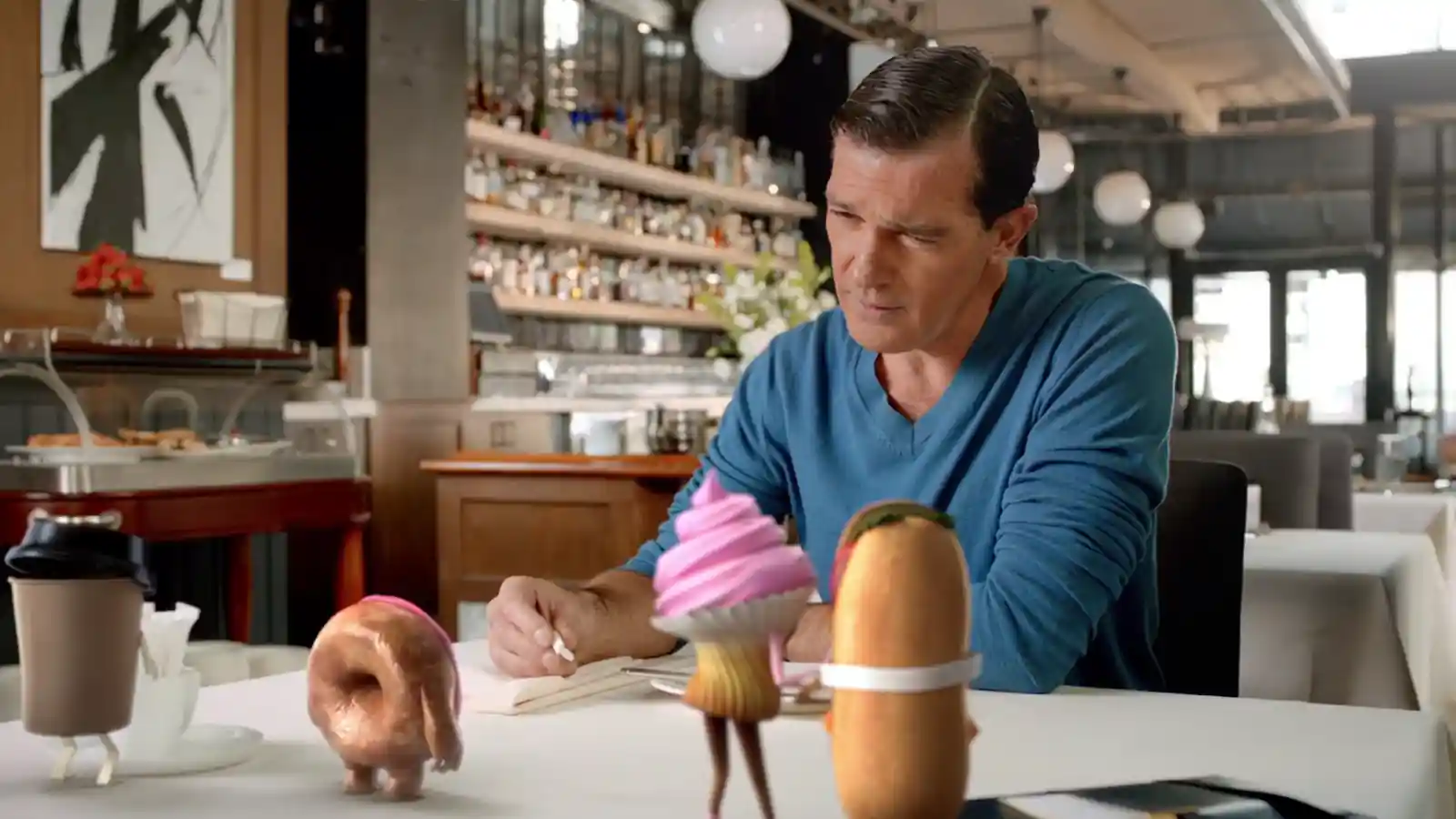
Across the restaurant table stands a pink doughnut with sprinkles, small arms and an expression of wounded disbelief. Behind it, a sandwich, a cupcake and a takeaway coffee cup form a miniature audience. Banderas approaches the situation with the seriousness of a man ending a relationship. The food treats his departure as a matter for negotiation.
The 2013 “Break Up with Lingering Food” commercial, featuring the characters used in Orbit and Extra advertising, gives a familiar product promise an unusually specific comic form. The meal is over; the aftertaste has become someone who refuses to leave. The film shown here carries the Extra brand.
“Whiten Up Your Day” uses a related idea: food becomes unwanted company that follows a woman beyond the meal. One commercial stages a breakup across a table. The other turns lingering food into an entourage. Both make gum part of the moment when a pleasant experience has overstayed its welcome.
A breakup needs someone who won’t accept it
The Banderas film starts with an ordinary restaurant scene. A waiter moves away from the table, a used plate sits in front of the actor, and his mouth movements draw attention to the aftermath of eating. The setting establishes the occasion before the commercial reveals its joke.
For several seconds, the camera stays close to Banderas as he addresses someone across the table. Then the reverse angle reveals the food characters gathered on the white tablecloth. The doughnut occupies the center, with the others arranged behind it.
That reveal gives the opening a second meaning. A conversation that could belong to a human relationship has been taking place with lunch. The familiar restaurant setting makes the absurdity easier to accept: the food is exactly where it should be, behaving in a way it absolutely should not.
The doughnut is a strong choice for the lead. Its thick pink frosting and sprinkles make it appealing, while its heavy little arms and changing expressions give it a stubborn presence. It can look hurt, argumentative and indignant without ceasing to look like something from the dessert counter.
The supporting characters help turn the exchange into a scene. The cupcake raises its arms; the coffee cup leans toward the doughnut. They react as though this disagreement concerns the whole group. Banderas has apparently acquired several emotional commitments simply by having lunch.
The celebrity plays it straight
Banderas does not need an elaborate costume or a reference to one of his films. A blue sweater and a restaurant table give him an everyday setting. His recognizable face supplies the celebrity appeal, while his restrained reactions leave room for the animated cast.
The size difference does much of the work. To the doughnut, the exchange is a major relationship crisis. To Banderas, it is an irritation small enough to address with one finger.
That becomes the film’s best physical joke. He reaches across the table and presses a finger against the doughnut’s face to quiet it. The close-up brings his hand and the animated character into direct contact. The doughnut briefly stops being an effect placed beside an actor and becomes a scene partner he can touch.
In a contemporary interview with Gloria, Banderas described working opposite animated characters that were absent during filming, with the director supplying the doughnut’s lines. The finished scene gives that technical setup a clear purpose. The hand, the eyeline and the reactions make the disagreement feel shared, however ridiculous its participants may be.
The pack gets its own punchline
The gum appears before the argument is resolved. Banderas produces a blue pack, and the film cuts back to the food characters’ reactions. Later, he puts gum into his mouth. The doughnut still gets room to protest.
That extra resistance matters. An immediate disappearance would reduce the characters to a product demonstration. Allowing the dispute to continue preserves the doughnut’s personality and gives the commercial another comic beat.
The decisive packshot is also an action. The Extra pack lands on the table, and the food characters tumble away around it. The object being advertised takes over the space they have occupied. For a moment, the product display and the punchline are the same image.
Banderas then gets up and walks away smiling. The closing “Eat. Drink. Chew.” message places the gum after the other two activities, giving the preceding scene a simple behavioral ending. Enjoy the meal, then bring it to a close.
There is a useful restraint in that proposition. The commercial does not need to persuade people to dislike food. It depends on food being desirable in the first place. What becomes unwelcome is its persistence after the occasion has passed.
“Whiten Up Your Day” takes the problem along
In “Whiten Up Your Day”, the following-food idea puts that persistence into a different kind of story. A contemporary account of Extra’s “White” commercial describes a woman followed through her social life by food characters, until chewing gum separates them.
The comparison with Banderas is revealing. His film concentrates its conflict at the table. The woman’s unwanted company turns the same broad sensation into something that travels with her. Leaving the meal behind physically does not mean being rid of it.
That gives the characters a practical storytelling job. A lingering taste is difficult to show. Food that follows someone is immediately legible: the meal is still making its presence felt. The commercial can dramatize the inconvenience through company and proximity rather than an explanation of what is happening inside a mouth.
Banderas’s breakup has the sharper individual encounter. A star negotiating with a doughnut gives the audience a specific relationship to follow. “Whiten Up Your Day” makes the premise broader: the unwanted guest can accompany someone into the rest of the day. The character idea works both as a conversation and as a continuing intrusion.
Why the food is allowed to be lovable
The obvious risk is that the characters become more attractive than the solution. A pink doughnut with feelings can be easier to root for than a packet of gum. Making the food entertaining gives the commercial personality, but it also makes its eviction a little less straightforward.
The Banderas film uses that tension well. We can enjoy the doughnut’s resistance while understanding why the actor wants to leave. The humor comes from giving a minor annoyance a wildly disproportionate emotional life. The product belongs in the joke because ending that annoyance is what the whole encounter has been about.
Across the two commercials, the strongest idea is the change in the consumer’s relationship with food. During the meal, it is welcome. Afterward, the same food becomes too attached. Orbit and Extra give that change a cast of characters—and give gum the final say about when lunch is really over.
Related reading: Puma’s 2010 World Cup commercial: the craft behind “Journey of Football”.