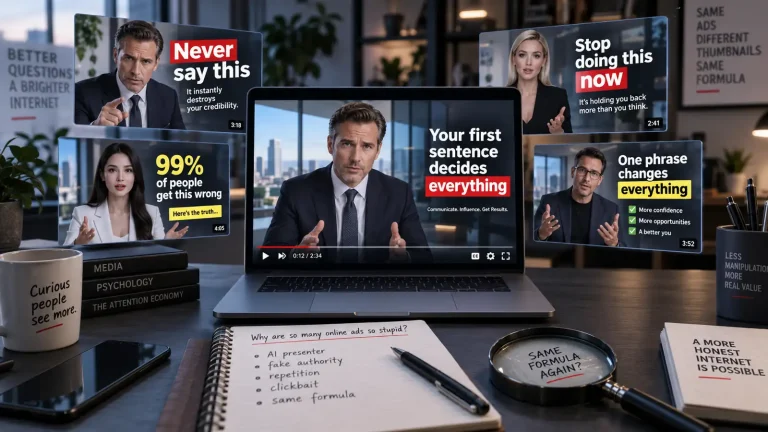

A person looks into the camera and tells you what works.
Maybe she is explaining why your communication skills are holding you back. Maybe a man in workout clothes is describing the routine that finally changed his body. Maybe someone who looks like a doctor, coach or podcast guest is explaining what your body has been doing wrong all these years.
And sometimes, there may be a small line somewhere on the screen:
“AI-generated content.”
Or:
“Generative AI used.”
One sponsored video we captured goes further: “Not a real life testimonial. Illustrative story. Results may vary.”
Those labels are useful.
But they also reveal why the obvious question — “Is this person real?” — is no longer enough.
A synthetic person can simply be a presenter. A real person can appear to recommend something they never recommended. A licensed avatar can have permission to use someone’s likeness without having any personal experience with the product.
What role is this person playing, what claim depends on that role, and can that claim be confirmed outside the video?
That distinction matters much more than whether you can spot an AI face.
Sometimes the AI person is just the presenter
There is nothing inherently deceptive about using an AI-generated person in an ad.
A useful example comes from American Eagle.
In a TikTok case study about an American Eagle campaign, TikTok describes the brand using AI avatars through its Symphony advertising tools. The avatars model clothing and talk about products, sizes and styling.
In that context, the synthetic person functions primarily as a model and presenter.
The relevant questions are therefore about the product.
Does the clothing look the way the ad suggests?
Are the sizing claims accurate?
Does the product description match what the buyer actually receives?
The fact that the presenter is AI-generated does not answer any of those questions.
And it does not automatically create a false testimonial, because the person does not necessarily need to be understood as a customer describing a personal experience.
That is an important baseline.
AI-generated person does not automatically mean deceptive ad.
Sometimes AI is simply part of the production process, much like animation, retouching or a human actor reading a script.
But the equation changes when the person is no longer just delivering the message.
It changes when the person’s identity, experience or authority becomes one of the reasons you are supposed to believe it.
A real face can still deliver a fake endorsement
This is the more important half of the story.
Professor David Taylor-Robinson is a real person.
He is a professor and a child public-health doctor.
And according to a Full Fact investigation, footage of one of his conference presentations was altered so that he appeared to recommend a menopause product.
The original talk was about health inequality.
The altered version presented him as recommending a Wellness Nest probiotic, discussing improvements among women he supposedly worked with and directing viewers toward a product link.
Taylor-Robinson told Full Fact he had not made that recommendation. He is also not a menopause specialist.
That creates a useful inversion of the usual AI question.
You could correctly establish that the man in the video exists.
You could correctly establish that he is a doctor and professor.
You could even find the original conference footage.
And you would still be wrong if you concluded that the recommendation was authentic.
The face was real.
The credentials were real.
The attributed endorsement was not.
Full Fact reported that the content had been posted by a TikTok profile called @better_healthy_life, which was later removed after Full Fact contacted TikTok.
What the available evidence does not establish is who created the manipulated video, which AI tool was used or whether Wellness Nest itself commissioned it.
That distinction matters too.
The case is evidence that a real person’s identity and credentials can be attached to a recommendation they did not make. It is not evidence that every company associated with a promoted product created the manipulation.
But for the viewer, the lesson is straightforward:
Confirming who the person is does not confirm what the person supposedly said.
Presenter, customer or expert?
This is why identifying the person’s role is more useful than staring at their eyes, teeth or blinking pattern.
An ad can place a person in several very different roles.
A presenter tells you about the offer.
“This app helps organize your daily tasks.”
Whether that person is human, synthetic or an actor does not determine whether the product claim is true. You can check the app.
A customer or testimonial makes the person’s supposed experience part of the evidence.
“I used this for three weeks and my problem disappeared.”
Now the identity and experience matter. Did this person actually use it? Is this their real statement? Is the result being represented accurately?
An expert or authority adds another layer.
“I recommend this because I see this problem in my patients.”
Now the qualifications, field of expertise and authenticity of the endorsement all matter.
A genuine medical title does not prove that the person made this particular recommendation.
And a synthetic face does not prove that the underlying information is false.
Those are separate questions.
That separation is useful because it still works when you cannot confidently determine how the video was made.
A licensed AI face still does not prove the claim
AI advertising also creates a more ordinary situation that can easily get lost between “real person” and “fake person.”
Some synthetic avatars are based on actual people who have agreed to their likeness being used.
TikTok, for example, describes Symphony stock avatars based on paid actors whose likenesses are licensed for commercial use, along with custom avatars for creators and brand representatives.
So it would be wrong to assume that every AI avatar uses a stolen identity or depicts a completely nonexistent human.
But permission solves only one question:
Was the likeness allowed to be used?
It does not automatically answer:
- Did this person use the product?
- Do they have the expertise the video appears to give them?
- Did they personally make this recommendation?
- Is the result being described actually supported?
Consent to use a face and evidence for an advertising claim are not the same thing.
Even the “podcast” may just be a format
The visual language of authority is changing too.
A microphone.
A studio.
Two people facing each other.
Alternating camera angles.
A confident host asking questions while an apparently knowledgeable guest answers them.
Not long ago, those details at least suggested that two people probably sat down and recorded a conversation.
They no longer prove that.
Creatify openly markets the ability to generate podcast-style and interview-style videos from scripts, including AI hosts, guests, dialogue and changing camera shots.
That does not mean Creatify users are producing fake expert endorsements.
It demonstrates something simpler.
The appearance of an interview is now a production format, not evidence that an interview actually took place.
The microphone proves there is a microphone in the image.
That is about as far as it gets you.
What does an “AI-generated” label actually tell you?
The screenshots we collected show several variations of AI disclosure.
One ad says:
“AI-generated content. Not a real life testimonial. Illustrative story. Results may vary.”
Others display:
“Generative AI used.”
Those statements answer different questions.
“AI-generated” or “Generative AI used” tells you something about how the content was produced or altered.
It does not tell you which part was generated.
It does not tell you whether a claim is true.
And it does not tell you whether the person is portraying a real customer.
“Not a real life testimonial” is more specific.
It tells you not to interpret the scene as a documented personal experience.
That is useful information.
But it still does not independently prove the other claims made in the ad.
And “Results may vary” tells you that outcomes can differ.
It does not prove that the displayed result happened, that it is typical or that the person shown achieved it.
One label cannot do the job of all the others.
That is why an AI disclosure should be read literally rather than treated as either a warning that everything is fake or a stamp saying everything else is verified.
You do not need to become an AI detector
There is an understandable temptation to approach these ads like a forensic puzzle.
Look at the fingers.
Watch the mouth.
Check the blinking.
Listen for strange pauses.
Zoom in on the skin.
Sometimes those clues are useful.
But they can also distract from the advertising claim itself.
Research on synthetic faces makes that even more complicated. A 2026 Journal of Vision study found that some AI-generated faces could produce strong impressions of trustworthiness even when they were not judged the most photorealistic.
That does not mean AI faces universally make better ads or that most people cannot detect them.
It means appearance and perceived trustworthiness are not the same thing.
So rather than trying to win an arms race against increasingly convincing video generation, there is a simpler test.
1. Identify the role
Is this person merely presenting the offer?
Are they supposed to be a customer describing what happened to them?
Or is their expertise part of the reason you are meant to believe the claim?
2. Isolate the claim
What exactly is the person asking you to believe?
- That they personally used the product?
- That it produced a certain result?
- That their professional experience supports the recommendation?
- That the product has a particular feature?
Separate those claims.
Confirming one does not confirm the others.
3. Look outside the video
If an expert is supposedly recommending something, can you find that recommendation on their own website, institutional page or verified channel?
If it is a testimonial, is there an original review or an explanation that the scene is a dramatization?
If the claim is about a measurable result, is there evidence for the result beyond the person saying it on camera?
The video can introduce the claim.
It should not automatically be the only evidence for the claim.
“Real” and “true” are no longer the same test
The rise of AI people in advertising creates a strange situation.
A face can be completely synthetic and deliver an accurate product description.
A licensed avatar can legally use someone’s likeness without that person being a customer.
A real customer statement can be performed by someone else.
And a real, identifiable expert can appear to say something they never said.
That makes “Is this person real?” an increasingly weak final question.
It is still worth asking.
It just should not be the last one.
The better sequence is:
What role is this person playing?
What claim depends on that role?
What evidence exists outside the video?
If the answers hold up, whether the presenter was rendered by a camera or generated by software may be the least interesting part of the ad.
If they do not, you do not need a perfect AI detector to know that the persuasive face on your screen has not actually proved the claim it was there to sell.