
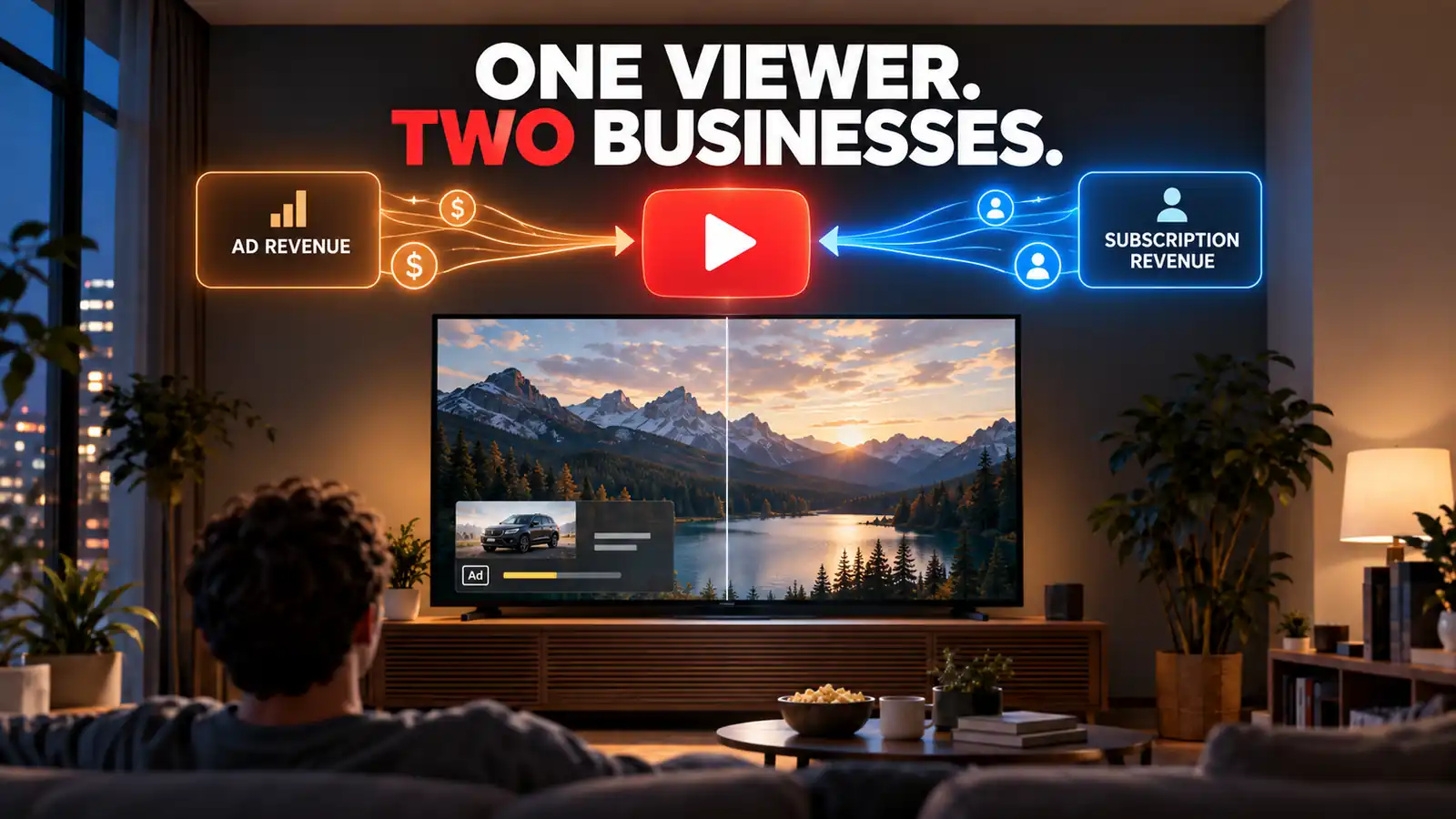
What this article covers
This article looks at how YouTube makes money from both advertising and Premium, and why public revenue figures cannot cleanly tell us which type of viewer is worth more. It examines how Premium revenue reaches creators, how YouTube markets the ad-free option, and whether the business incentive to sell Premium means the platform has reason to make the free experience worse.
YouTube has built an unusual business.
It sells advertisers access to your attention.
Then it sells you a subscription that removes many of those ads.
That naturally raises a question:
Does YouTube make more money when you watch ads, or when you pay for Premium?
It sounds like the kind of thing a few public revenue numbers should settle.
They do not.
Alphabet reports enormous YouTube advertising revenue. YouTube also has a large and growing subscription business. But the public numbers do not line up neatly enough to calculate a trustworthy “average value” for an ad-supported viewer and compare it with a Premium subscriber.
And even if they did, averages would hide the more interesting part.
A viewer who watches occasionally in a low-priced advertising market is economically different from someone who watches for hours every day in a market where advertisers pay heavily to reach them.
A single Premium account can also cover more than one person.
So the answer is not simply:
Premium user = worth X. Free user = worth Y.
What we can see much more clearly is the business model.
YouTube wants both groups.
And it actively sells both experiences.
YouTube has two very large ways to make money from viewers
Advertising is still enormous.
According to Alphabet’s 2025 annual report, YouTube generated about $40.4 billion in advertising revenue in 2025.
That tells us subscriptions are no side project.
And the subscription business is still growing. During Alphabet’s Q2 2026 earnings discussion, chief business officer Philipp Schindler said YouTube’s subscription business was growing faster than advertising, with Music and Premium helping drive that growth.
But none of those numbers answers the question most viewers actually want answered:
Would YouTube rather have me watching ads or paying for Premium?
The problem is the denominator.
The obvious calculation does not work
A tempting calculation goes something like this:
- Take YouTube’s total advertising revenue.
- Divide it by the number of YouTube users.
- Compare that with the price of Premium.
- Whichever number is larger tells you which user YouTube values more.
Unfortunately, that creates a very precise answer to the wrong question.
For one thing, there is no clean public count of the exact group we would need: people who are actively monetized through ads during the same period as the revenue figure.
A YouTube user is not the same thing as an ad-supported user.
A video view is not the same thing as an ad impression.
And an available ad slot is not the same thing as an ad that was actually shown and paid for.
The Premium side is not much easier.
YouTube said in October 2025 that Music and Premium had more than 125 million subscribers, including trials. That figure combines products and includes people who were not necessarily paying.
Meanwhile, subscription revenue is not reported as a clean standalone YouTube Premium number that can simply be divided by that subscriber count.
Then there are individual plans, family plans, student plans, different prices by country, promotional offers and bundled subscriptions.
One family subscription, for example, can represent several viewers but only one bill.
The neat division starts getting messy very quickly.
Which is exactly why we should resist making up an “average Premium user value” from numbers that were never published to answer that question.
The same viewer can also be worth very different amounts through ads
Even within the free version of YouTube, users are not economically interchangeable.
Imagine two people.
One watches a few videos per week and skips most ads.
The other watches hours of YouTube every day, including long videos with multiple opportunities for advertising, in a market where advertisers are competing heavily for that audience.
There is no reason to assume those two viewers generate the same advertising revenue.
Now add devices, content type, local advertising demand and whether an ad was actually available at the moment YouTube had an opportunity to show one.
The comparison gets even less universal.
For the light viewer, converting to Premium might plausibly create more subscription revenue than the small amount of advertising they would otherwise generate.
For an extremely heavy viewer in a lucrative ad market, the advertising being given up could be much more substantial.
Public data does not let us calculate the difference reliably.
That is not a failure of arithmetic.
It is a lack of the right inputs.
Creators can still get paid when Premium removes the ads
Premium does not simply remove an ad and leave the creator with nothing.
YouTube says Premium membership revenue is distributed to creators based on how much Premium members watch their content.
So a Premium viewer can support a creator without seeing a platform-served ad.
That is one reason comparisons based only on whether an ad appeared can be misleading.
The money moved through a different path.
But there is another easy mistake here.
If a creator earns more from a particular Premium view than from a particular ad-supported view, that does not automatically mean YouTube made more profit from the Premium viewer.
Revenue, creator payouts and YouTube’s profit are three different things.
Alphabet still has content costs, infrastructure costs, payment costs, music-rights obligations and other expenses.
A creator’s payout tells us what the creator received.
It does not reveal YouTube’s margin on that person.
This sounds obvious when written out.
It becomes less obvious when someone posts a screenshot of creator revenue and tries to turn it into YouTube’s entire business model.
YouTube openly sells the escape from advertising
What is much easier to document is that YouTube actively markets a different experience to people who do not want ads.
YouTube Premium removes platform-served ads before and during videos and adds other benefits such as background playback and downloads.
YouTube also has Premium Lite, a cheaper tier built around watching most content without ads, while some advertising can still appear around music, Shorts, search and browsing.
That is an interesting product in itself.
It shows that YouTube is not simply dividing the world into:
ads or no ads.
It is selling different levels of escape from advertising.
The company’s response to ad blockers makes the choice even more explicit.
YouTube’s official help page on ad blockers tells viewers to allow ads or subscribe to Premium, and warns that continued use of blockers can result in playback being blocked.
There is not much ambiguity in the business proposition:
Let the advertising work, or pay for the version that removes it.
That does not tell us which option is more profitable for every person.
It does tell us both are monetization paths YouTube wants to preserve.
Has YouTube ever used more ads to push people toward paying?
This is where the question gets more uncomfortable.
It would be too strong to say there has never been any evidence of YouTube using advertising pressure to encourage subscriptions.
There is a historical example.
In 2018, YouTube music chief Lyor Cohen discussed increasing promotional pressure on people who used YouTube heavily for music.
After his comments attracted attention, a YouTube spokesperson told Pitchfork that a specific group of users who treated YouTube like a paid music service might encounter more ads or promotional messages encouraging them to subscribe.
The company also pushed back against the idea that YouTube was broadly increasing the ad load for everyone.
That distinction matters.
It is evidence that YouTube has, at least in a limited historical context, considered extra advertising or promotional pressure as a way to encourage a particular group toward a subscription.
It is not evidence that YouTube’s current general strategy is to make everybody’s ads progressively worse until they surrender and buy Premium.
And it certainly does not prove something even more specific: that YouTube deliberately serves repetitive, irrelevant, annoying or low-quality ads because bad advertising makes Premium easier to sell.
We do not have evidence for that.
The incentive is more complicated than “make free YouTube miserable”
YouTube obviously has a reason to make Premium attractive.
If paying changed nothing about the experience, the subscription would be much harder to sell.
Removing ads is one of its most visible benefits.
So there is a genuine commercial incentive for the paid version to feel better than the ad-supported version.
But YouTube has another commercial incentive moving in the opposite direction.
It needs the ad-supported version to remain worth watching.
If frustration makes someone buy Premium, YouTube keeps the viewer and gains a subscriber.
But frustration has other possible outcomes.
- The viewer can install an ad blocker.
- Watch less YouTube.
- Move some viewing elsewhere.
- Or simply become less receptive to the advertising being shown.
Those outcomes are not equivalent to a Premium conversion.
Advertisers also need an audience.
Creators need viewers.
And YouTube’s advertising business depends on people continuing to spend huge amounts of time on the free service.
That is why the idea that YouTube would simply maximize annoyance until everybody pays is too simple.
A platform with two revenue models has to manage two revenue models.
Even some ad changes point in the opposite direction
YouTube has also made changes it describes as attempts to make advertising less disruptive.
That does not prove every viewer suddenly received a better experience.
And it does not mean fewer ads.
But it is at least evidence that YouTube publicly recognizes a trade-off between monetization and the viewing experience.
An ad opportunity that causes a viewer to leave is not automatically a better ad opportunity.
YouTube’s business is not simply about putting the maximum possible number of interruptions into every minute.
It is about monetizing attention without destroying too much of the attention being monetized.
So does YouTube make more from you with ads or Premium?
The frustrating answer is:
We cannot tell from the public data.
Not for you specifically.
And not as one trustworthy global average that applies to everyone.
YouTube’s published numbers do not give us a clean Premium revenue figure, a perfectly matched paying subscriber base, an equivalent ad-supported viewer count and all the costs needed to compare profit per person.
Anyone producing a very precise global answer is probably filling those gaps with assumptions.
What we can say is more useful.
YouTube has built two large businesses around the same underlying activity: people watching video.
One monetizes your attention through advertising.
The other monetizes your willingness to pay for a different experience.
Creators can earn from both.
YouTube actively promotes both.
And the company has a clear reason to make the paid option attractive without making the free option so intolerable that users stop being useful to either side of the business.
That leaves a narrower version of the suspicion many viewers have:
If YouTube sells Premium partly by making the paid experience better than the ad-supported one, doesn’t it have an incentive to keep Premium attractive?
Yes.
The contrast between an ad-supported product and a less ad-heavy or ad-free product is part of what gives Premium value.
There is even limited historical evidence that YouTube has used additional ad or promotional pressure with a specific audience to encourage subscription.
But that is still a long way from proving the broader claim that YouTube deliberately makes today’s ads repetitive, irrelevant or bad in order to force people into Premium.
The incentive to make Premium attractive is real.
The claim that YouTube deliberately makes ads worse to sell it is not proven.