What this article covers
This article examines the Halloween films from Fanta, Twix, Rivian and Pringles, focusing on how their ideas develop and what their products contribute. It looks at the stories, jokes and brand connections, with brief checks on the wider campaigns and offers. The analysis distinguishes creative judgments from claims about sales, audience recall or commercial effectiveness.
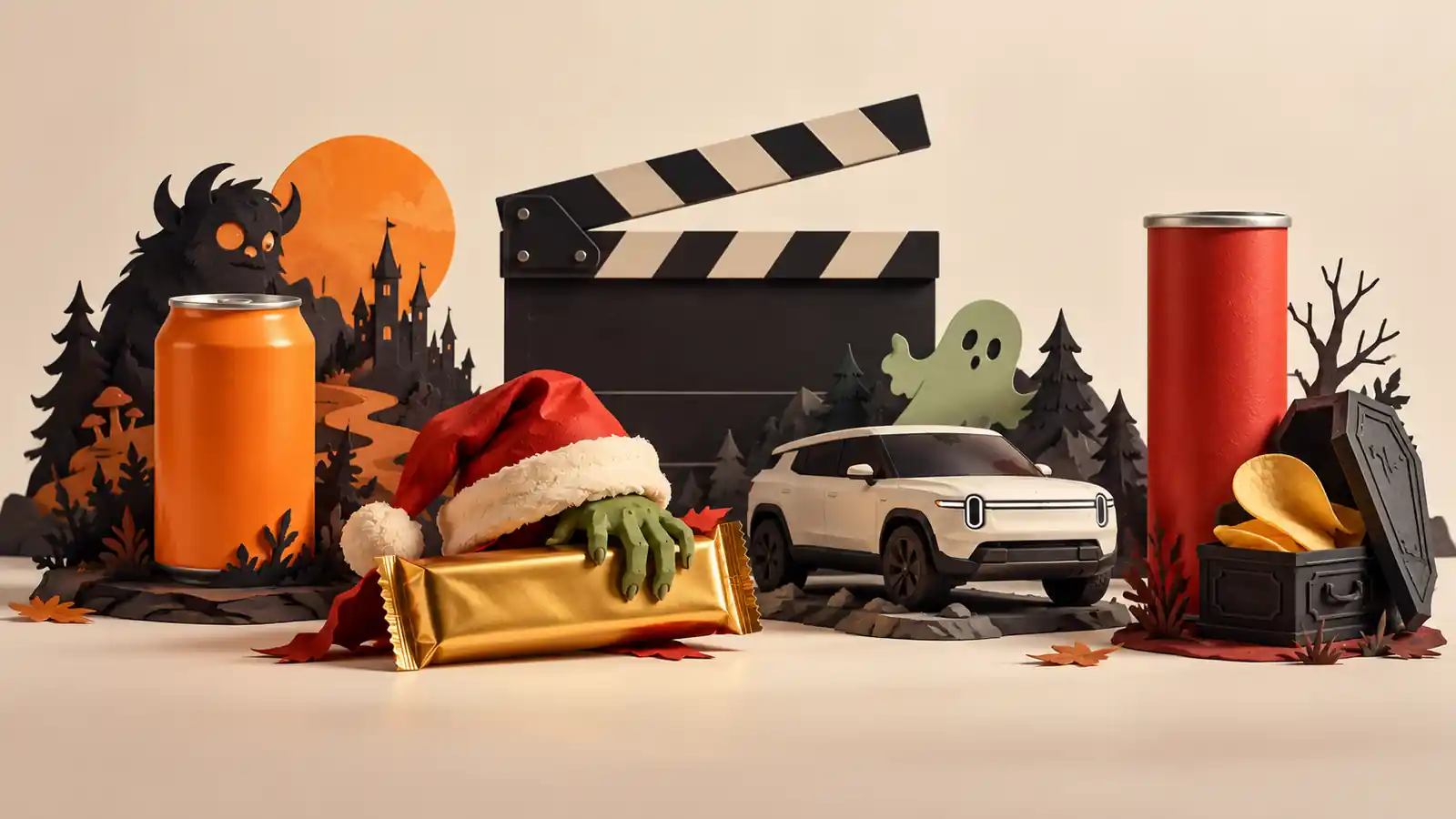
Fanta has monsters fighting through a city. Twix has a decomposing Santa handing out candy. Rivian has Bill Murray back on ghost duty. Pringles has a can waiting in a casket.
They share a holiday, but the products have very different jobs. A drink can give a fantasy world a playful personality. A candy bar can supply the logic for a mixed-up holiday. A vehicle can become part of the entertainment, and a snack container can become the joke itself.
The question is what the films do with those premises. Does the joke develop? Does the spectacle lead somewhere? And what makes the result belong to the brand paying for it?
Imagining a different logo is one useful test. It cannot tell us whether an ad is funny, engaging or well told. These four campaigns show why both the brand connection and the creative execution deserve attention.
Fanta: Finding the drink inside the fantasy
Fanta’s Haunted Universe introductory trailer gives its monsters lives beyond haunting people. There is a werewolf at a DJ console and elaborate machinery on a motorcycle, alongside a glowing vessel in a dark, candlelit setting. Familiar horror ingredients become parts of a bigger fantasy world.
The opening narration establishes a powerful elixir, while dramatic music and the sounds of destruction give the conflict blockbuster scale. That grand treatment makes the late change of perspective especially useful. Amid the wreckage, two men sit with Fanta cans. A little later, a dog licks a glowing pumpkin-like head.
The monsters can have their epic struggle. There is still a drink to enjoy, and even a creature can become something a dog wants to lick. The humor comes from shrinking the significance of everything that preceded it. What looked monumental becomes somebody else’s background scenery; what looked threatening becomes an object of canine affection.
That change of scale gives the trailer a welcome point of view. Its fantasy is more appealing when it makes room for indifference and silliness alongside destruction. The men with their cans also give Fanta a recognizable place in the scene: an ordinary pleasure survives the theatrical chaos. Orange lighting makes the spectacle visually compatible with the drink, but this contrast gives it a personality.
The crowded mythology is less focused. A glowing artifact, several monsters and elaborate machinery provide plenty to look at, but divide attention among possibilities before any one character has much room to carry a story. The elixir offers a familiar fantasy objective; it does less to distinguish this particular adventure.
The trailer is consequently more persuasive as an invitation to an invented world than as a self-contained story about a drink. Its ending supplies a clear comic idea that the larger mythology only partly develops. That is a limitation of this film, rather than a verdict on the entire campaign: Coca-Cola presents it as an opening chapter, with more stories to follow.
Collectible packaging gives the broader world a presence on store shelves. AI is part of its production context: Marketing Dive identifies GRAiL as an AI-powered studio, while Coca-Cola describes a human-led creative process using technology. Neither establishes how every shot was made, or resolves the creative question of what all that spectacle adds up to.
Twix: Two holidays in one unwelcome visitor
Twix compresses its premise into a single body. Zombie Claus has Santa’s red hat and white beard attached to a decaying face. Halloween and Christmas are already sharing the frame before anyone explains Hallowmas.
In the 40-second film, he meets a young woman in a domestic setting and hands her a Twix. The contrast is small and concrete: an extravagantly unpleasant visitor takes part in the familiar business of giving someone candy.
His rough voice adds menace to a figure associated with generosity. Giving out candy makes him behave like Santa without making him look any less alarming. That mismatch gives the scene a comic tension beyond the costume: accepting a treat means dealing with the creature offering it.
The dialogue develops the mixture through competing seasonal responses and the possibility of having both, connecting the holidays with Twix’s cookie-and-candy combination. But it mostly finds further ways to express the contradiction already visible in his face. The costume delivers the surprise; the exchange elaborates its logic more than it changes the situation.
The handoff is therefore a useful physical payoff. The two holidays produce an actual gift, and the gift repeats the idea of a combination. It gives the scene something to do beyond explaining its visitor.
By the time “Two Is More Than One” appears, the premise is already clear. The line works as a concise signature linking the sketch to Twix, rather than a fresh punchline. That makes this a neatly sustained character joke, with less invention after the initial reveal. Its strength is the uncomfortable gift-giver, not the amount of lore suggested by the film’s title.
Twix brought Hallowmas back for a second season in 2026, alongside seasonal Twix Skulls and a fan photo-and-video contest. The character gives people a clear mixture to imitate, though a returning campaign is not evidence of an established audience tradition.
Rivian: The car gets to participate
Rivian begins with a considerable advantage: Ghostbusters supplies a recognizable world, Slimer supplies a problem, and Bill Murray supplies a familiar person to deal with it. The film can get straight to the encounter without building a mythology from scratch.
The launch film opens with Slimer in a disorderly kitchen. Outside is the white Ghostbusters-themed Rivian, carrying both the franchise’s identity and the vehicle maker’s name. The setup has the ingredients of a miniature movie reunion.
Murray’s casual delivery brings the supernatural business down to the level of a routine service call. Food becomes part of his approach to Slimer, and the ghostly activity is treated as a manageable inconvenience. The familiar Ghostbusters music and effects provide recognition; the unhurried human response provides a counterweight to the spectacle. Nostalgia here brings a comic attitude as well as familiar faces and sounds: extraordinary trouble is another job to get done.
But the scene most useful to Rivian’s argument is a finger pressing a touchscreen control marked “Ghost Trap.” The vehicle’s interface enters the action. Later, a split-screen pairs Murray with a themed cockpit and the message “Ghostbusters Halloween mode. Only from Rivian.”
That sequence gives the car more responsibility than transporting a celebrity. The screen becomes part of how the fantasy operates. The final cockpit image then changes the proposition from watching Murray handle a ghost to having a little of that world inside your own vehicle.
That connection needs a clear boundary. The customized Ecto-R1 vehicles, with physical Ghostbusters equipment and body details, are promotional builds. Rivian’s separate, temporary Halloween software experience coordinates themed displays, lighting and audio; features vary across vehicle generations. The software experience changes how the car presents itself, rather than supplying the film’s apparatus or paranormal capabilities.
The distinction makes the ad more interesting. The fictional control exaggerates a real quality of the product: software can change how the vehicle looks and sounds to the people using it. Halloween becomes a way to present the car as something playful and adaptable.
The limitation is that much of the film’s personality arrives with the franchise. Murray’s manner and Slimer’s misbehavior have a history Rivian did not create. Rivian’s own character comes through most clearly in the playful use of its screen and vehicle systems. That is a credible contribution to the entertainment, though the car’s participation is more distinctive than the ghost-catching story itself.
Pringles: The container carries the joke
Pringles starts with an object people already recognize and gives it a deeply unsuitable new assignment.
In the Once You Drop film, a red can rests on the white pillow of an open casket. Later comes a tall, cylindrical Pringles urn. Then a hearse holds rows of red cans. The same familiar shape moves through the different functions of a funeral business.
That repetition is the film’s most useful creative device. The can does not merely appear beside a Halloween prop. It takes the prop’s place, becomes the prize, and fills the vehicle used to carry the dead. Each setting finds another application for the same packaging.
Dan Madden, identified in the film as a real funeral director, gives the premise a professional presenter. His measured delivery treats the outrageous request as something a customer might reasonably need explained. The funeral setting supplies the solemnity; his businesslike manner supplies permission to discuss the ridiculous object within it. The humor depends on that agreement to take the request seriously.
There is a factual seed behind it. In 2008, the Associated Press reported that some of packaging designer Fredric Baur’s ashes had been buried in a Pringles can.
The closing “Once You Drop, The Pop Don’t Stop” gives the packaging joke a verbal partner. Reworking familiar brand language makes death part of the product’s existing vocabulary. A different bag of snacks would require a different object, a different visual sequence and a different line.
The campaign premise is more adventurous than the film’s explanatory structure. Documents, a website address and a prize presentation move the host through the practical business of entering. They fit the administrative setting, but explaining the promotion does not continually develop the comedy.
The repeated can is what keeps that explanation connected to the original absurdity. In the casket it is a substitute for the deceased; as an urn it becomes a plausible object; in the hearse, multiplication turns it into excess. These are variations on the idea, rather than repeated instructions. The hearse gives the premise a larger visual expression when the presentation could otherwise settle into paperwork.
The now-closed sweepstakes offered a bespoke urn and $28,080 cash representing its advertised 200-year supply. Its comic “Will and Taste-ament” was nonbinding, according to the official rules. The prize materialized the packaging joke without requiring a burial commitment.
What remains when the monsters leave?
A strong brand connection gives a film a reason to exist. It does not finish the creative work. Once a costume, a licensed character or an unusual object has established the premise, the ad still has to find something interesting to do next.
That is the distinction these campaigns make useful. Repetition can reveal another side of a joke, or merely explain it again. Spectacle can build toward a change of perspective, or distribute attention among ideas that never quite develop. A product can be central to either result.
When watching the next elaborate campaign, look for the moment when the product gets something to do. Then ask what the film builds from that moment: another surprise, a character, a satisfying turn? That reveals more about its creative quality than counting logos. It cannot establish sales, audience recall or preference, but it can explain why an ad deserves attention after its premise is clear.
Related reading: Inside Nexera’s AI Ad Machine